Imagine that there is no single metronome inside you keeping the rhythm of life. Instead, hundreds of independent clocks are working simultaneously in your head, sometimes synchronizing and sometimes running at cross-purposes. It is precisely this picture of brain function that researchers from the Institute of Science Tokyo describe, overturning the established notion of centralized time perception.
A new study, published in the prestigious journal Nature Communications, demonstrates that biological systems do not rely on a single "central timer." Instead, various regions of the cerebral cortex are capable of dynamically switching between synchronous operation and completely independent counting. This mechanism allows for the maintenance of computational stability while remaining flexible in the face of environmental changes.
An Experiment Without Pauses
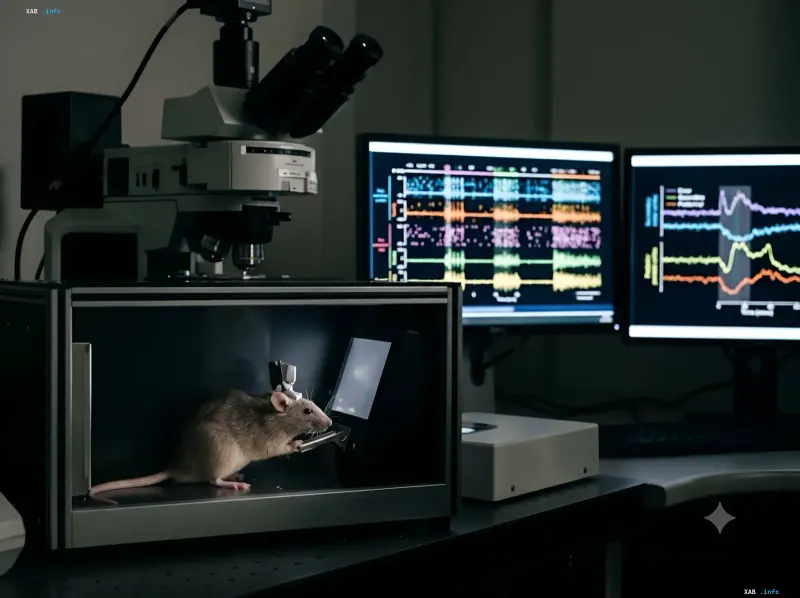
To peer into the mysteries of neural activity, scientists developed a complex task for laboratory mice. The animals were trained to expect a reward after alternating intervals of 6 and 12 seconds. A key feature of the experiment was the absence of pauses between attempts. This forced the rodents to continuously update their internal sense of time, not giving them the opportunity to "reset" their mental stopwatch to zero.
By the end of the training, the mice demonstrated impressive accuracy: they learned to predict both time intervals and forecast which interval would follow next. To record this process, the team used two-photon calcium imaging, allowing them to observe the activity of thousands of individual neurons in real time.
Observations were conducted simultaneously in two areas critical for planning and working memory: the secondary motor cortex and the posterior parietal cortex. It turned out that cells in both areas activated in a strict sequence, creating a complex algorithm in which information about elapsed seconds was encoded.
The Mystery of Errors: Why the Brain Gets Off Track
The most interesting discovery occurred during the analysis of errors. Scientists identified two fundamentally different types of failures in neural activity:
- Synchronous failures: both regions made mistakes simultaneously, demonstrating complete coherence.
- Independent failures: one cortical region continued to count seconds accurately, while the other got off track, indicating their temporal independence.
Statistics revealed a surprising fact: independent errors occurred approximately twice as often as coordinated ones. This proportion was maintained across all tested animals, suggesting a fundamental principle of brain function rather than random deviations.
The Mathematics of Balance: How Nature Works
To understand the mechanism of this natural balance, researchers created a computer model consisting of two recurrent neural networks subject to common background noise. The simulation shed light on how this mechanism works:
Synchronization is managed by a small number of rare connections between areas, while global noise forces them to work autonomously. Neither of these forces takes the upper hand; instead, the system finds a mathematical compromise. This balance allows brain regions to "communicate" when necessary without merging into a single, inflexible clock mechanism.
From Biology to Robotics
Understanding the architecture of a distributed time perception mechanism could help solve a long-standing engineering problem. The mechanism, in which rare connections and a common background ensure a balance between autonomy and synchronization, could become a fundamental principle for designing new systems.
Implementing such algorithms will allow for the creation of adaptive robot control systems and artificial intelligence models. Such systems will be capable of dividing tasks into independent computational streams and instantly synchronizing them when necessary, mimicking the amazing flexibility of the living brain.