In February 2024, the scientific community witnessed an event that had previously remained only a theoretical model. An international group of geophysicists recorded the process of the formation of a new section of oceanic crust directly for the first time in history. Observations were conducted on the Southeast Indian Ridge, where, under the pressure of tectonic forces, a section of the seafloor split apart by more than two meters.
Observing the Invisible
The Southeast Indian Ridge is an underwater mountain chain separating the Australian and Antarctic tectonic plates. It is here, in the divergence zones, that magma from the mantle rises, solidifies, and forms new Earth's crust. The mechanism of this process has been known to science for decades, however, observing it directly in the moment had never been possible.
To realize this ambitious task, researchers deployed a complex technical network along a 100-kilometer section of the ridge. The equipment included five hydrophones for recording underwater sounds and seismic waves, as well as 15 autonomous acoustic beacons. The principle of the system was based on the exchange of sound signals every four hours, which allowed for tracking the distances between instruments with the highest accuracy and recording the slightest shifts of the seabed.
The Event That Changed the Data
After the equipment was installed, the hydrophones recorded a series of powerful underwater earthquakes. Immediately after the seismic activity, acoustic measurements showed a displacement of some instruments. Calculations confirmed the scale of the phenomenon: individual sections of the seafloor separated by at least 2 meters. An additional sensor also recorded a sharp change in depth, becoming independent evidence of the rift that occurred.
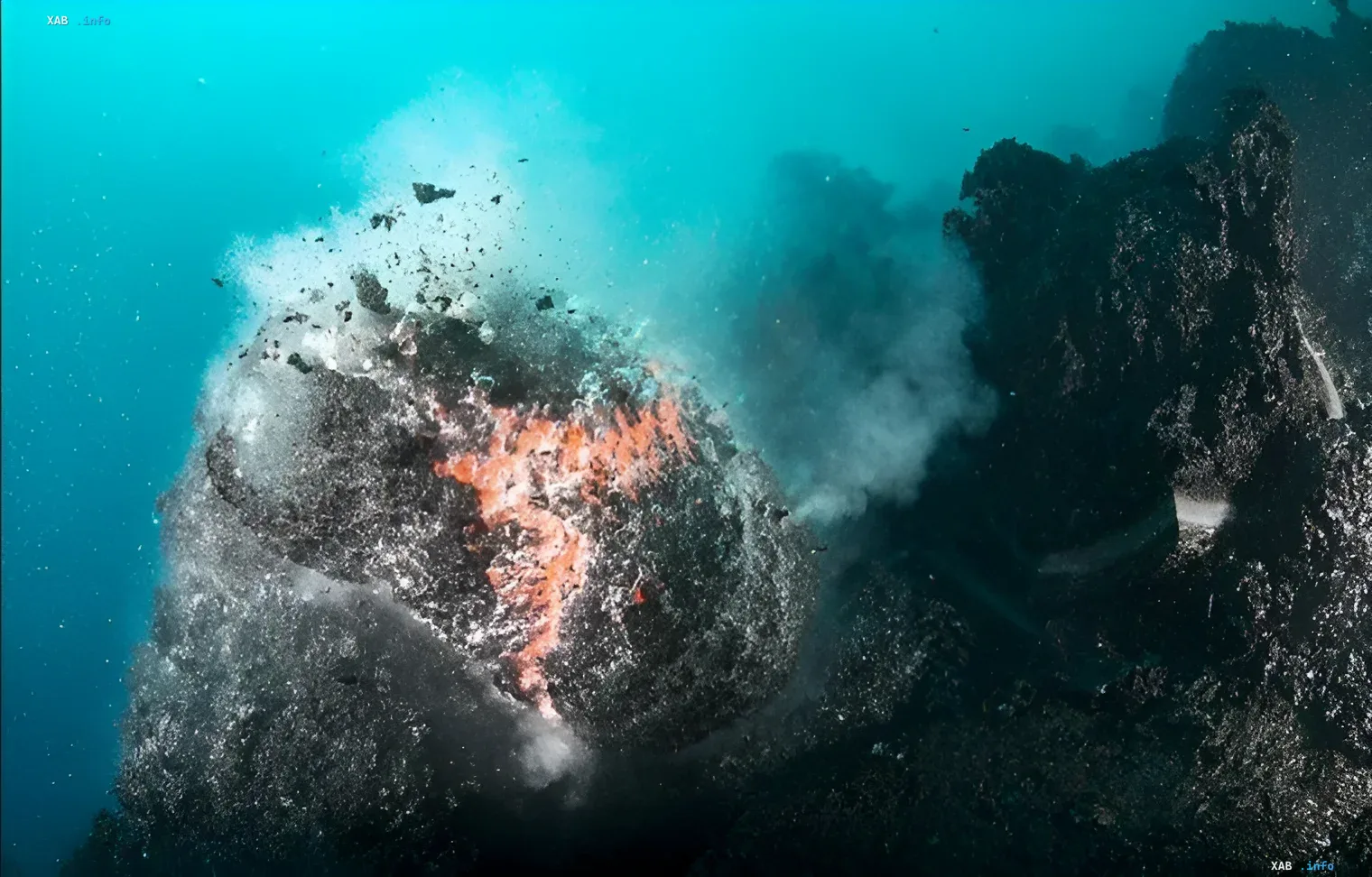
According to the authors of the study, over a few days, about 160 million cubic meters of lava rose between the diverging plates, filling the resulting crack. Scientists believe that the magma came from an underground reservoir that had been accumulating molten rock for many years. After this reservoir was emptied, individual sections of the ocean floor began to subside.
A Scale Exceeding Expectations
The results of the expedition turned out to be significantly larger than predicted. Jean-Yves Royer, a marine geophysicist from the French National Center for Scientific Research (CNRS) and one of the authors of the study, noted that the team expected to see a vertical displacement within a few centimeters. Reality exceeded expectations: measurements showed a change in depth of up to 4.2 meters.
According to the researchers' calculations, during this event, stress that had been accumulating due to the movement of the Australian tectonic plate for approximately 30–60 years was released.
The Significance of the Discovery
The authors of the work emphasize that such processes constantly form new oceanic floor, however, due to the inaccessibility of mid-ocean ridges, it is practically impossible to observe them in real-time. The obtained data allowed for the first time to directly trace how the oceanic crust rift occurs. The results of the study were published in the prestigious scientific journal Nature.