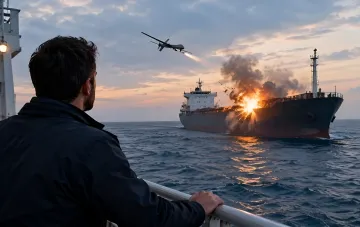
In 2026, the Black Sea has turned into one of the most dangerous maritime navigation zones in the world. According to NATO military representative Colonel Martin O'Donnell, the number of recorded incidents has increased nearly tenfold compared to last year: while there were fewer than 50 in 2025, the figure has reached 400–500 this year. Alliance representatives state that tensions in the region have come right up to NATO's borders, creating the risk of direct involvement of the US and its allies in an armed conflict.
Tenfold Increase in Incidents and Casualties
O'Donnell emphasized that the Black Sea has become even more dangerous for sailors than the Strait of Hormuz amid the US-Iran standoff. Since the beginning of 2026, at least 40 crew members have died in the Black Sea waters, whereas 25 fatalities were recorded in the Strait of Hormuz over the same period. According to the Alliance, this statistical skew indicates the systemic nature of threats in the region rather than isolated episodes.
Black Sea Fleets Working at Their Limit
Alliance member states with access to the Black Sea — Romania, Bulgaria, and Turkey — are finding it increasingly difficult to control their maritime borders. Romanian Navy Captain Miha Iordache stated that the Romanian fleet is operating on the verge of its capabilities, constantly neutralizing explosive objects using divers and underwater drones. «Four years ago we were ready for one drifting mine, and now we face dozens of drifting drones. We lack the manpower, personnel, and equipment to cope with all commercial vessels and drones,» he noted.
Threat to Global Trade and Food Security
The Black Sea remains of critical importance for global trade: key flows of grain and fuel pass through the region. O'Donnell warned that any disruptions in food and energy supplies will have global consequences that will also hit the United States. In this context, Turkey, whose civilian vessels have previously been targeted by drone attacks, publicly urged the warring parties to take immediate and concrete measures to ensure navigation safety, pointing out the risks to food security.
Article 5 and Pressure on the Eastern Flank
Amid growing threats on NATO's eastern flank — specifically, the recent fall of Russian cruise missiles in southeastern Poland and regular violations of Alliance airspace by drones — Brussels emphasizes its readiness to defend allies in accordance with Article 5 of the NATO Charter. «I would say there should be no doubt about NATO's readiness and ability to act,» stated Alliance spokesman Martin O'Donnell.
Negotiation Deadlock Over the "Silence Regime"
The issue of navigation safety and establishing a ceasefire in the Black Sea remains one of the most difficult in the negotiation process. Kyiv previously stated that Ukraine expects pressure from states directly dependent on maritime supplies to prompt Russia into establishing a «silence regime» in the Black Sea. At the same time, as Turkish Foreign Minister Hakan Fakan (Hakan Fidan) explained, Russia refuses to conclude a separate truce in the Black Sea without signing a full and long-term peace agreement with Ukraine, and the negotiation process itself is effectively blocked due to the territorial issue of Donbas.