Extended power outages turn daily routines into a series of compromises: candles are dim and dangerous, flashlights do not illuminate the entire room, and phones run out of charge quickly. Under such conditions, LED fairy lights stop being exclusively festive accessories and become full-fledged, albeit modest, sources of light. However, the market is flooded with models featuring various power types, brightness levels, and stated autonomy. Without understanding key characteristics, it is easy to buy a device that will only provide decorative flickering and die within a couple of hours. We break down what to look for when choosing fairy lights for blackouts, based on recommendations from the US Federal Trade Commission (FTC), the US Department of Energy (DOE), and manufacturer data.
Lumens, Not Watts: The Main Brightness Indicator
The first and most important thing to check on the packaging or product description is luminous flux, measured in lumens (lm). According to the FTC clarification, this exact parameter determines how much light a device actually emits: the more lumens, the brighter the illumination. Watts, conversely, reflect electricity consumption rather than illumination levels. Therefore, relying solely on a fairy light's power consumption when buying is a common mistake that leads to purchasing a dim model with inflated energy use. For blackout use, a reasonable minimum luminous flux is considered to be from 50 lm, and for full work area illumination — from 100–200 lm.
Power Type Determines Autonomy
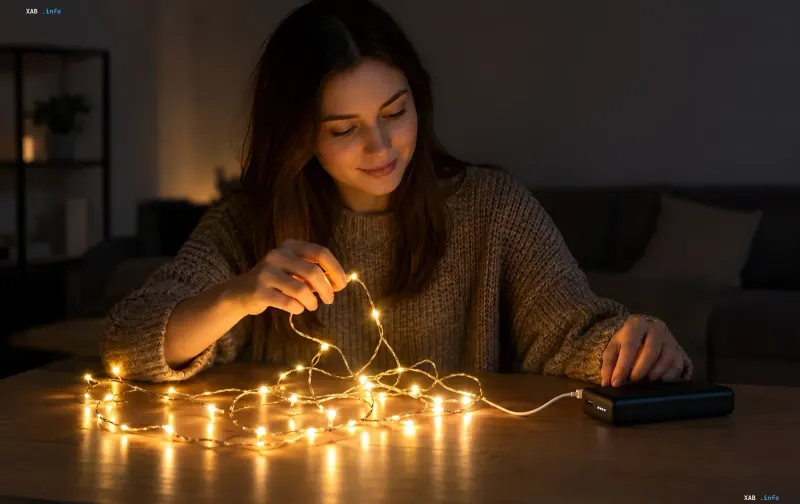
LED fairy light models can run on standard batteries, a built-in rechargeable battery, a USB port, or an external power bank. Each option has its pros and limitations. Battery-powered fairy lights do not require an outlet and can function even during a total blackout; however, their autonomy depends directly on the battery type, the number of LEDs, and the device design. Built-in batteries are more convenient to use but require periodic recharging. USB models and power bank-powered lights offer maximum flexibility as they can be connected to any current source. A telling example is provided by manufacturer Decathlon in the specifications of one of its rechargeable fairy lights: at a luminous flux of 50 lm, the device works for up to 17 hours, at 100 lm — about 9 hours, and at 200 lm — approximately 6 hours. This clearly demonstrates how much the lighting mode affects battery life: the brighter the light, the faster the charge depletes.
LED Lifespan Is Not the Same as Autonomy
Packaging often features the specification "LED lifespan in hours." It is important to understand that this indicator does not mean how long the device can continuously shine on a single charge. It refers to the expected operational lifespan of the LEDs themselves before a noticeable drop in brightness. According to the US Department of Energy, quality LED light sources have an estimated lifespan of 30,000 to 50,000 hours or more. Nevertheless, the electronic components of the device — drivers, controllers, connectors — can fail significantly earlier than the LEDs themselves begin losing brightness. Therefore, when evaluating product reliability, one should pay attention not only to the declared LED lifespan but also to the overall construction and electronics quality.
Certification and Warranty: Markers of Quality
One of the objective criteria for reliability is the presence of independent certification. The ENERGY STAR program, for instance, includes testing decorative light strings for compliance with energy efficiency and electrical safety requirements. Certified models typically carry a manufacturer warranty of at least three years, serving as an additional signal of trust in product quality. If you are buying fairy lights in a store, ask the salesperson to turn on the device: this allows you to evaluate the real tint of light, illumination uniformity, and the operation of various modes. When buying online, it is advisable to look for video reviews of the specific model rather than limiting yourself to promotional photos, and to cross-check stated characteristics with packaging and manual info.
The Main Rule of Selection
In summary, the key principle when choosing LED fairy lights for blackout conditions sounds simple: focus on known battery capacity, clearly stated autonomy time, and clear brightness characteristics in lumens. A large number of bulbs and an attractive price do not guarantee good lighting on their own. A string light that works for six hours at 200 lm from a built-in battery will be far more useful during a power outage than a model with 500 bulbs but without power and brightness specifications. Before purchasing, you should match your real lighting needs with the exact numbers in the specification and choose a device that fulfills precisely those tasks.