
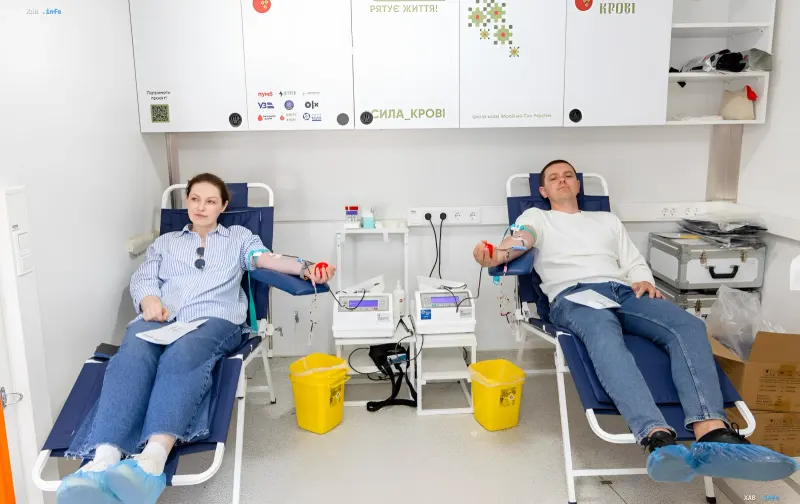
In the conditions of modern war, donor blood has become a strategic resource, comparable in importance to weapons and ammunition. Understanding this critical necessity, the company 'Epitsentr' has turned one-off events into a systematic corporate project. Together with the Armed Forces Blood Center and the 'Kolo' Charitable Foundation, the retailer holds regular donor days to provide medics with life-saving material for wounded soldiers.
A systematic approach to saving lives
For 'Epitsentr', this is already the seventh large-scale donation. Over the past two years, company employees have donated nearly 500 liters of blood. These volumes help medics promptly save the lives of military personnel and civilians during the most difficult moments. The events are part of the company's large-scale project 'Saving Lives', which has been supporting medics working both in the rear and at the front since the beginning of the war.
The initiator of turning one-off events into systematic work was Oleg Kostenko, an advisor to the General Director on sanitary-hygienic and anti-epidemic issues. A candidate of medical sciences and an epidemiologist with more than 40 years of experience explains that a company with 40,000 employees simply could not stand aside.
"Our employees are also called up to the Armed Forces. They fight, get wounded, and we see the medical, social, and psychological problems they face afterwards. Then I paid attention to the fact that our country has serious problems with blood," Kostenko says.
The reality of frontline medicine
According to medics, blood today is a critically necessary resource for the Armed Forces, just like ammunition or military equipment. The need for it is constant, and blood donation is practiced even at the very front line. Sometimes blood and instruments are delivered to soldiers via drones.
In field conditions, compliance with asepsis and antisepsis rules is extremely difficult, but medics do everything possible. Kostenko emphasizes the importance of timely transfusion: every soldier has a tourniquet, but it can be kept on for no more than an hour and a half, otherwise tissue necrosis begins. Timely blood transfusion is the only chance to bring a person back from the brink of death.
The situation on the front can be critical. There have been cases where a hryvnia coin accidentally got under the tourniquet. Due to the coin being tilted, the vessel was not fully compressed, the person lost a huge amount of blood and died. In such extreme conditions, military medics are forced to work at the limit of their capabilities.
The scale of corporate charity
The idea of systematic blood donation arose about two years ago. The first Donor Day took place in the company's central office, and the number of volunteers exceeded the technical capabilities of the medics, who could accept up to 120 people a day. The schedules for specialist visits are booked months in advance, so 'Epitsentr' took the initiative to contact the Blood Center, offering its help.
The Blood Center supported the idea, seeing the retailer as a reliable partner. After the first event, colleagues began asking when the next campaign would take place. Over two years, about seven campaigns were held, with the number of volunteers exceeding a thousand people. In the first days, the limit for medics was exceeded so much that some employees were upset at not being able to donate in time.
Before the start of corporate campaigns, many employees donated blood individually or in family pairs, visiting blood centers at Syretska or Okhmatdyt. Now, the company has created conditions to make this process mass and accessible right at the workplace, turning charity into the main driving force in the rear.


