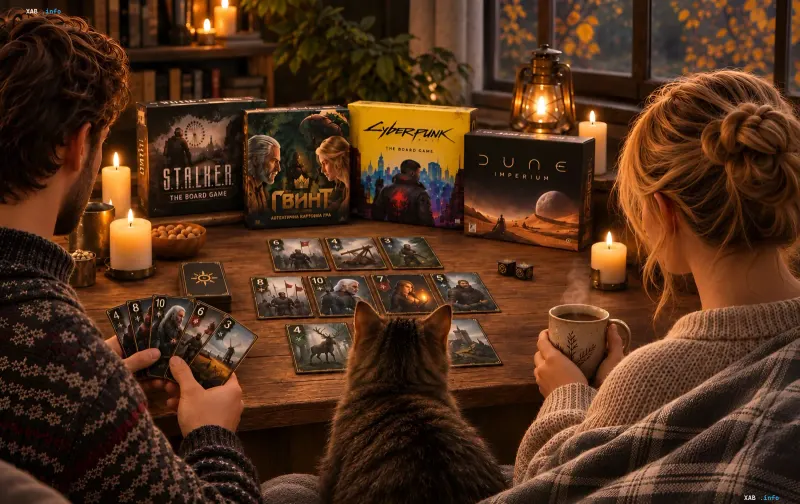
Board games have long ceased to be a niche hobby for a narrow circle of enthusiasts. Today, publishers actively adapt popular video games, movies, and literary universes for tabletop play, creating robust mechanics that let players experience the atmosphere of the original without a screen. Styler editor Yulia Lyushneva has compiled a selection of five tabletop adaptations, each offering a unique approach to a familiar world—from card strategy to cooperative survival. All of these games work autonomously and require no electrical power grid connection, making them especially relevant for cozy evenings with friends.
Gwent: A Card Strategy from the Witcher Universe
Fans of The Witcher 3: Wild Hunt fondly remember Gwent, the card mini-game for which Geralt was ready to postpone main quests indefinitely. To mark the video game's tenth anniversary (2015–2025), the project received a proper physical release, and players can now compete not only against AI opponents but also in a live circle. The box contains 436 cards and five factions: Northern Realms, Nilfgaard, Scoia'tael, Skellige, and Monsters. Each faction has its own features, strengths, and unique approach to the game. The mechanics are built around deck building, deploying units across three combat rows, and trying to win two out of three rounds. However, victory does not always go to the one with the most powerful cards; it is critically important to correctly calculate your own moves and adapt your tactics to the opponent. Each card references characters and events from the Witcher world, and the illustrations are executed at a level that allows you to spend hours examining the deck even outside of a gaming session.
Cyberpunk 2077: Street War for Night City
In the universe of Cyberpunk 2077, power is not divided solely among corporations—the streets of Night City are controlled by dangerous gangs constantly fighting for territory, resources, and influence. This very conflict forms the basis of the tabletop adaptation. Players lead one of four gangs: Maelstrom, Tyger Claws, Valentinos, or Voodoo Boys. The objective is to capture districts, recruit fighters, conduct underground deals, and engage in firefights. Each faction possesses its own abilities and playstyle, and ultimate victory is determined by accumulated street reputation. The choice of gang becomes a key strategic element, dictating the entire subsequent course of the game. In one session, players might rely on military confrontation, while in another they focus on technology and resource control. Detailed miniatures and familiar Night City locations lend the game a special atmosphere and nostalgic tint.
Dune: Imperium: Politics and War in Frank Herbert's World
Frank Herbert's Dune universe is renowned for political intrigue, power struggles, and the planet Arrakis's most valuable resource—the spice melange. In the tabletop adaptation Dune: Imperium, players become leaders of Great Houses trying to exert influence in the Imperium. The mechanics combine deck building with worker placement on the board: participants gather resources, send agents to various factions, strengthen political positions, and participate in military conflicts. Victory points can be earned in a wide variety of ways, meaning there is no single 'correct' strategy here. The game allows players to achieve superiority not only through military force but also via political decisions. The constant choice between resources, influence, and conflict participation makes each session unique: even the strongest army does not guarantee victory if opponents have better calculated their next moves.
S.T.A.L.K.E.R.: Cooperative Survival in the Zone
The grim Exclusion Zone, dangerous anomalies, mutants, and the hunt for valuable artifacts—all of this is familiar to fans of the Ukrainian S.T.A.L.K.E.R. series. The tabletop adaptation translates this experience into a cooperative format where participants jointly complete story missions. Players explore territories, look for gear, fight enemies, and try to avoid anomalies. The game features a campaign of sequential tasks and a separate Zone Survival mode designed for standalone play sessions without tying into the storyline. The cooperative format differs fundamentally from the single-player video game experience: here, team actions must be coordinated, and tactics change when one participant wants to risk everything for an artifact while others insist on a more cautious route.
Star Wars: Empire vs. Alliance
The confrontation between the Galactic Empire and the Rebel Alliance forms the basis of another board game inspired by an iconic franchise. Participants find themselves on opposite sides of the conflict and try to destroy the opponent's bases. Each player starts with a small deck that gradually strengthens with new characters, ships, and abilities. The mechanics rely on building power and tactically placing units, allowing players to replicate the scale of space battles in a compact tabletop format.
All five games in the selection share one thing: they let you re-experience familiar universes in a new way, independent of screens and network connections. At a time when power outages are becoming an increasingly realistic scenario, tabletop adaptations of iconic franchises transform from mere entertainment into a way to maintain a connection with your favorite worlds in any environment.