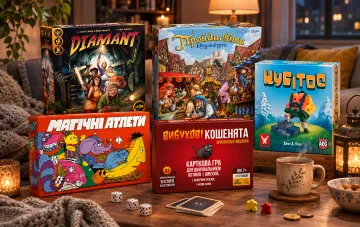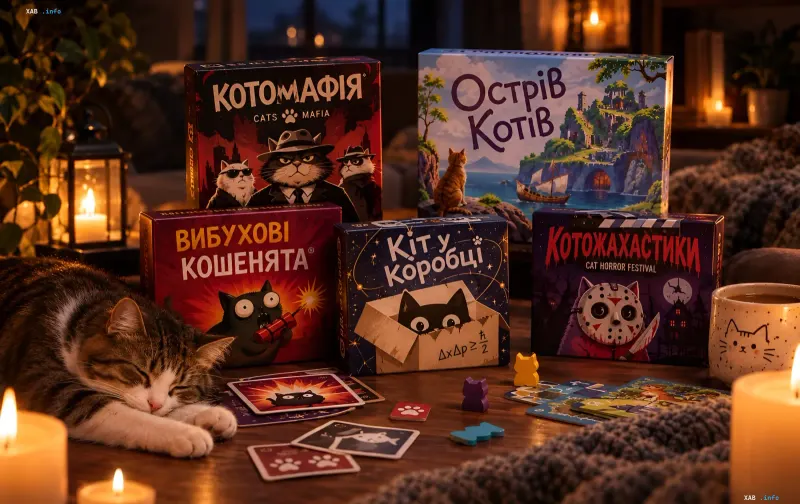
When the evening gets dark and you're not in the mood for boring TV series, board games become one of the most accessible ways to spend an evening with friends or loved ones. And if the main characters at the gaming table are cats who cause explosions, turn into mobsters, and make opponents think hard about every move, the evening promises to be truly memorable. Julia Lyushneva, editor of the lifestyle project Styler (RBC-Ukraine), has compiled a list of five board games in which fluffy characters take center stage.
"Exploding Kittens": excitement and unpredictability in every card
"Exploding Kittens" is a card game where the player's main goal is not to draw a so-called exploding kitten from the deck. If this happens, the participant is out of the game, unless they have a special defuse card. However, the mechanics are not limited to simple random card drawing: participants can skip turns, peek at the deck, force opponents to draw extra cards, and change the course of the game. The winner is the one who managed to avoid the explosion until the very end. According to the author of the selection, the game is especially valued for the speed with which the situation changes: even when it seems that everything is under control, one card can ruin all plans, and the ability to harm opponents adds to the excitement.
"Cat Horror Festival": a feline horror movie night
"Cat Horror Festival" invites players to imagine a film festival where all the lead roles in horror movies are played by cats. Before the screenings begin, an unfortunate incident occurs: the film reels get mixed up, and the participants have to restore the tapes. Players collect card sets with fragments of movies and complete tasks; to win, one needs to be the first to complete three tasks by correctly combining cards. On them, you can find cat versions of iconic horror movie characters, including Freddy Krueger and Hannibal Lecter. The author of the selection notes that the game's design makes no less of an impression than the gameplay itself, and the rules are quite simple and do not require long study.
"Cat Mafia": psychological confrontation in feline roles
In "Cat Mafia" (Cats Mafia), cats transform into dangerous mobsters, civilians, and other characters of the criminal world. Behind the colorful design hides the psychological game "Mafia," familiar to many, where victory depends on the ability to convince others and detect lies. Participants secretly receive roles, after which a confrontation between the mafia and civilians begins: during the day, everyone discusses suspects and votes, and at night, the characters perform their hidden actions. One player becomes the moderator and controls the course of the game. In the author's opinion, in this game, the result depends not so much on the cards as on the behavior of the participants themselves: you can correctly guess who is hiding their role but fail to convince the others. Cat images add an element of humor to a familiar mechanic.
"Cat in the Box": a strategy inspired by quantum mechanics
The name of the game "Cat in the Box" refers to the famous thought experiment involving Schrödinger's cat. However, instead of complex scientific explanations, participants are in for an unusual card strategy where even the suit of a card is not predetermined. Each card has a number, but the player chooses its suit only at the moment of playing it. Moreover, the same combinations of number and suit cannot be repeated, so it is necessary to carefully watch the played cards, predict the number of tricks won, and avoid a "paradox" that can ruin the result. The author emphasizes that the ability to determine the suit of cards yourself creates an interesting paradox: it would seem that this should simplify the game, but in fact, every decision gradually limits subsequent moves, forcing you to think not only about the current combination but also about what possibilities will remain at the end of the round.
"The Isle of Cats": saving the fluffies on the island
In "The Isle of Cats," unusual colorful cats inhabit an island, but their home is threatened with destruction. Players have only five rounds to save as many fluffy friends as possible and transport them to their own ships. Space on board is limited: each cat is represented by a tile of an unusual shape that needs to be properly placed on the ship. Participants collect fish, get baskets to rescue animals, search for treasures, and try to combine cats of the same color into families. You can lose points for poorly filled cabins. The author notes that behind a rather cute story lies a full-fledged strategy: you want to save all the cats, but you have to constantly count resources and find a place for everyone, and watching the ship gradually fill up is a pleasure in itself.
The Styler selection demonstrates that board games with cats are not just a cute theme for children, but a full-fledged genre with diverse mechanics: from fast card duels to deep strategy and psychological confrontation. All five games are suitable for evening leisure with friends and allow you to combine the pleasure of socializing with the excitement of competition.