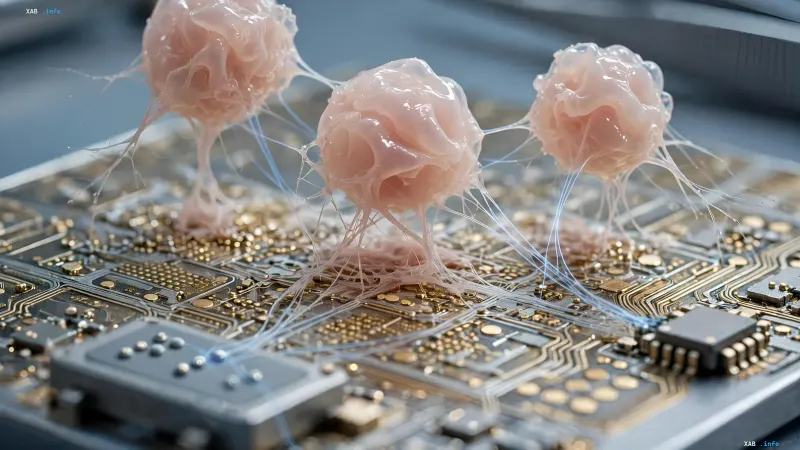
Researchers at the University of Bristol have conducted an experiment in which three miniature brain models grown in the laboratory participated in processing tactile signals corresponding to the letters of the Braille alphabet. As a result, the system combining biological neural tissue and a machine learning algorithm recognized input signals with an 83% accuracy. For comparison, using a single organoid yielded an accuracy of only 61%. The work demonstrates that laboratory-grown neural tissue is capable of performing non-trivial computational functions within biohybrid systems, albeit under strictly limited conditions.
What Are Organoids and How Were They Connected to the System
Organoids are three-dimensional models of organs or their distinct structures derived from stem cells in a laboratory setting. In this experiment, human brain organoids measuring less than one millimeter were used, each containing roughly 10,000 neurons and supporting cells. The scientists placed them on multi-electrode arrays—devices that simultaneously sustain the viability of the neural tissue, deliver electrical stimuli to it, and record the response activity. This specific configuration allows the organoid to be viewed not as a passive object, but as an active element of a computational circuit.
How the Experiment Was Built
To generate input data, the researchers used a tactile sensor capturing signals corresponding to the 26 letters of the Braille alphabet. The resulting data were converted into electrical impulses and fed directly to the organoids. Next, a machine learning algorithm analyzed the resulting neural activity and determined which letter corresponded to the input signal. Thus, the neural tissue acted not merely as a conductor, but as an intermediate information processing link between the artificial sensor and the computer recognition system. This fundamentally distinguishes the approach from a classical neurochip, where the signal passes through a predetermined electronic circuit.
Why Three Organoids Work Better Than One
The key result of the experiment is the increase in accuracy from 61% to 83% when moving from one organoid to three. The authors hypothesize that this is due to natural differences between individual samples: they have dissimilar synaptic connections between neurons, different developmental stages, and varied background activity. Consequently, the same input signal triggers responses that are not completely identical and may contain complementary information. At the same time, the researchers emphasize that the exact mechanism of this synergistic effect has not yet been established, and it remains an open question for further research.
Noise Resilience and Experiment Limitations
The team additionally tested how the system behaves under artificial noise conditions. The scientists distorted signals corresponding to Braille letters and compared the recognition quality based on organoid responses with the direct analysis of noisy data by the same algorithm. Under noisy conditions, the system with three organoids maintained accuracy better than the purely electronic variant. This indicates that the biological component can be useful not only for signal transmission, but also for information processing when input data degrades. At the same time, the authors clearly limit the interpretation: the experiment does not prove that organoids have "learned to read" in a human sense, understand letters, or are capable of learning from their own experience. Signal recognition was demonstrated in a single specially organized task with a pre-determined encoding method.
What's Next: From Letters to Textures and Feedback
The next stage of work, according to the team's plans, is to test how organoids cope with more complex tactile signals: surface textures, object edges, and various types of touches. The scientists also intend to move to closed-loop systems with feedback, where the outcome of actions influences subsequent signals fed to the neural tissue. This will allow testing whether organoids are capable of adapting based on experience. However, the researchers warn that individual differences between organoids can, on the one hand, enrich the computational process, and on the other hand, complicate the creation of predictable and standardized biohybrid devices. Thus, the path from a laboratory experiment to an applied product remains long and requires solving a number of fundamental and engineering challenges.