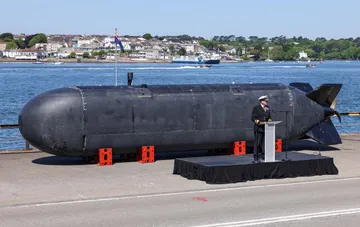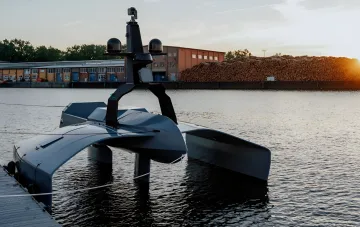
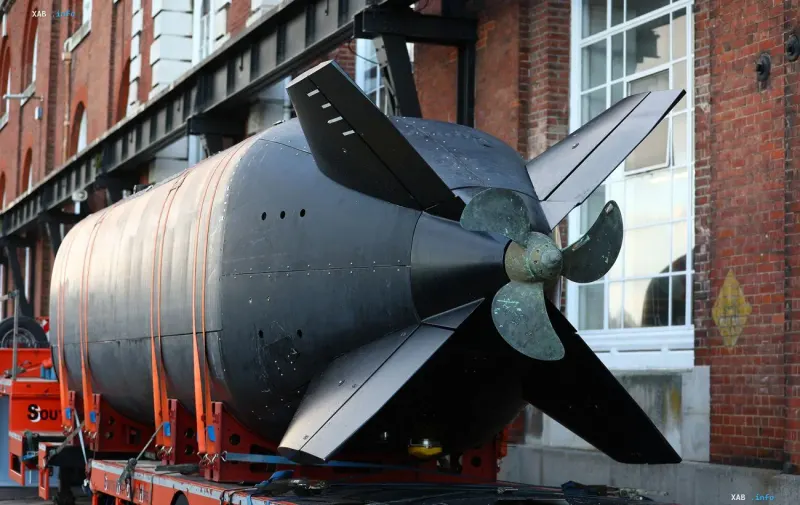
The United Kingdom and the United States have taken an unprecedented step in global naval practice: for the first time in history, a heavy torpedo was launched not from a crewed submarine, but from an unmanned underwater vehicle. The tests took place last week in the waters of the United Kingdom and, according to London's assessment, represent a "significant step in the development of future underwater technologies." This was reported by the UK government, and the details of the operation were confirmed by RBC-Ukraine, Kommersant, and other publications.
Excalibur: 12 Meters of Autonomy in the Depths
The torpedo carrier was the 12-meter unmanned underwater vehicle Excalibur, built in Plymouth, Britain. It was from this device that a heavy torpedo of American design, developed jointly by the US and Australia, was launched. The munition is intended to strike surface ships and submarines, including those operating at great depths. According to the British government, neither the UK nor the US had previously conducted such launches from unmanned underwater vehicles, making this test truly unique on a global scale.
From Reconnaissance to Strike: A Paradigm Shift
The Excalibur test marks a qualitative shift in the role of unmanned underwater systems. If previously unmanned underwater vehicles were mainly regarded as means of reconnaissance, observation, and intelligence gathering, the launch of a heavy torpedo opens up the possibility for them to carry out direct strike missions without a crew on board. This fundamentally changes tactical calculations in naval confrontation: the adversary can no longer rely on the assumption that the underwater threat comes exclusively from crewed submarines with their predictable signatures and maneuvering zones.
AUKUS and a New Wave of Autonomous Military Technologies
In the British government, the tests are directly linked to the development of autonomous military technologies within the framework of the trilateral AUKUS partnership — the United Kingdom, the United States, and Australia. In parallel, London and Washington announced a new partnership in the field of artificial intelligence and autonomous systems. Under it, the British Rapid AI Delivery Taskforce and the American Chief Digital and Artificial Intelligence Office are working on creating compatible AI and autonomous technology systems. This includes, in particular, the application of such systems for the protection of critical infrastructure — from maritime communications to airspace. The Excalibur test is part of the broader AUKUS program to create new underwater autonomous capabilities, and the partnership also provides for the development of a new generation of attack submarines for the United Kingdom and Australia.
Global Context: The Race for Maritime Drones
The torpedo launch from Excalibur comes against the backdrop of the rapid development of unmanned maritime systems in various countries around the world. Ukraine, in particular, actively uses unmanned surface boats for reconnaissance, mining, and striking maritime targets, which has become one of the most notable examples of the application of such technologies in a real conflict. In the US, meanwhile, a fundamentally new approach to production has been mastered: on August 10, it was announced about the American unmanned boat TF-179, whose hull was manufactured using large-format 3D printing. The combination of these trends indicates that the underwater and surface unmanned fleet is becoming not an auxiliary tool, but a full-fledged component of the maritime doctrine of leading naval powers.