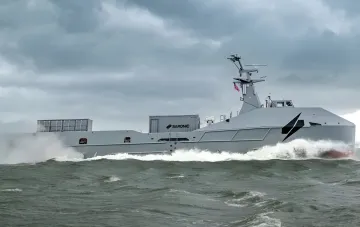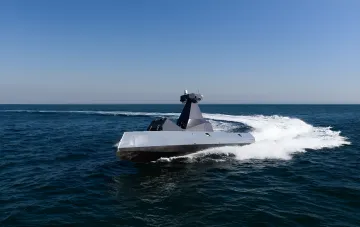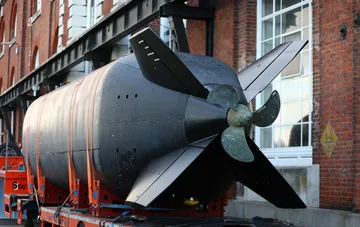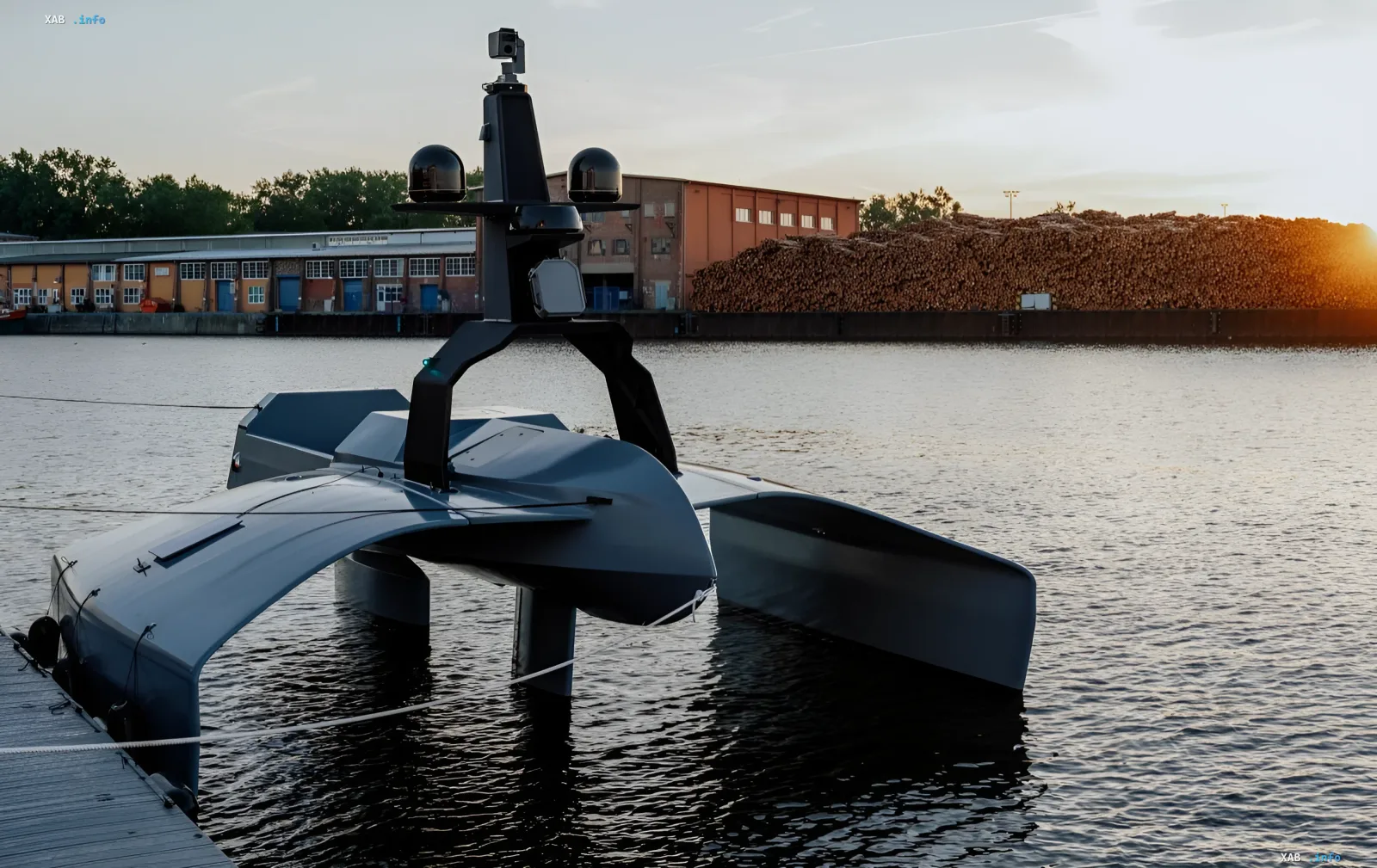
Quantum Systems, a German defense company whose unmanned systems have been in use in Ukraine for several years, has announced an expansion of its portfolio into the maritime domain. On the sidelines of NATO exercises in Portugal, organized jointly by the Portuguese Navy, the University of Porto (FEUP), the NATO Centre of Maritime Research and Experimentation (NATO CMRE), the NATO Joint Centre for Maritime Unmanned Systems (NATO JCGMUS), and the European Defence Agency, the company presented two new vehicles — the surface vessel Seavex and the underwater unmanned vehicle Subvex. Both devices are designed for prolonged surveillance, the protection of critical maritime infrastructure, and counter-drone operations, and will undergo sea trials in the near future to confirm their stated performance in real-world conditions.
Two Vehicles for Two Environments
Seavex is an unmanned surface vessel (USV) designed for long-duration reconnaissance missions: the vehicle is capable of remaining at sea for up to two months. Its equipment includes a surveillance radar, a radar for drone detection, as well as electro-optical sensors with on-board data processing. A key feature of Seavex is its role as a "mother platform": the vessel can launch and recover aerial UAVs, as well as dock, charge, and retrieve data from underwater drones, acting as a node in a distributed system.
Subvex is an underwater unmanned vehicle (UUV) with artificial intelligence capabilities, able to operate at depths of up to 6,000 meters. The vehicle is equipped with a sonar and acoustic detectors, can move autonomously for up to four days, and operate in groups of several units simultaneously. In passive mode, Subvex can remain on the seabed for weeks, conducting covert monitoring. Together, the two systems cover reconnaissance from the water surface to deep-water zones and are applicable to the protection of maritime borders, anti-submarine surveillance, and the defense of maritime infrastructure.
A Unified Software Platform: MOSAIC UXS
Both new vehicles are integrated into the MOSAIC UXS software platform, which already unites the company's aerial and ground unmanned systems. This allows a single operator to receive data from different domains in a unified interface and to combine systems from various manufacturers. As co-founder and co-head of Quantum Systems, Florian Ziebel, explained, the company "started with air, expanded to land, and is now moving to the sea," and the real step forward lies not in adding yet another domain, but in linking them together. Dirk Zademack, Vice President of the Quantum Maritime division, added that the main challenge of maritime operations is the vastness of the spaces involved with a limited number of crews and equipment, which is precisely why the same principle of collective drone operation applied in the air and on land is being transferred to the maritime domain.
Strategic Context: From Reconnaissance to Interception
The launch of the maritime division is not Quantum Systems' first move beyond purely reconnaissance drones and is another step in transforming the company into a global defense player with a full portfolio of unmanned technologies. Earlier this year, the company announced an investment in Ukrainian manufacturer WIY Drones to expand production of the STRILA air-defense interceptor — its main vehicle against Shahed-type targets. Subsequently, WIY Drones, together with Quantum Systems, upgraded the machine: STRILA-2 received a rocket booster borrowed from the German Jäger drone, allowing the drone to take off almost vertically and gain several kilometers of altitude within seconds, as well as artificial-intelligence software that ensures independent target recognition and capture even under active enemy electronic warfare conditions.
Outlook and Sea Trials
The next stage for Seavex and Subvex will be sea trials designed to confirm their stated performance in real-world conditions. For Ukraine, where maritime reconnaissance and the protection of critical infrastructure have become one of the key priorities, the emergence of such systems from a partner already working with the Ukrainian military could expand the available tools for monitoring water areas. At the same time, the final tactical and technical specifications will only become known after the trials are completed, which makes the company's current statements preliminary.