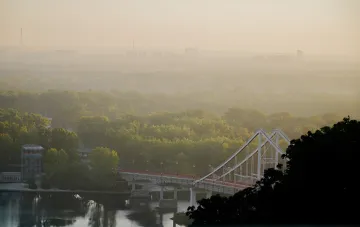
On the morning of September 17, the Kyiv Regional Military (State) Administration reported a temporary deterioration in the quality of ambient air in the city of Brovary. The OVA press service clarified that the cause was "the result of an enemy attack," and according to daily average data from monitoring stations, the main pollutant was fine particulate dust. Head of the Kyiv Regional OVA Timur Tkachenko emphasized in his Telegram channel that the region was under attack "almost all of yesterday, the entire night, and the morning" — a massive strike by drones and ballistic missiles on peaceful settlements and civilian facilities.
Scale of the strikes and impact on infrastructure
According to Tkachenko, the Obukhiv, Brovary, Fastiv, and Bucha districts were hit. In total, 33 facilities were damaged, the most in the Brovary district (14) and the Fastiv district (10). Among the damaged were private homes, warehouse and production premises, and transport. The official stated that there were no casualties, and services are continuing to address the aftermath. He later added that during the morning drone attack in the Brovary district, a warehouse was damaged, where a fire broke out that is being fought by the relevant services; information on the scale of the damage is being clarified.
Air monitoring: 16 stations and stable gamma background
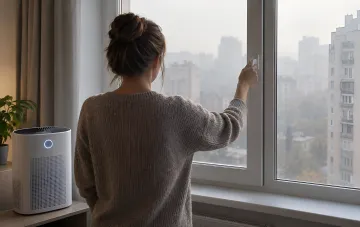
Specialists of the Kyiv Regional OVA explained that ambient air monitoring in the region is carried out around the clock at 16 observation points, in automatic mode with uninterrupted power supply to the equipment. According to their data, no exceedances of permissible levels of chemical and biological substances in the ambient air have been recorded in other settlements of the Kyiv region, and the level of gamma radiation in the region steadily corresponds to the natural background. Until the situation improves, residents of Brovary are advised to limit their time outdoors and keep windows closed.
Contradictory data
There is a discrepancy in the assessment of the scale of pollution. The Kyiv Regional OVA directly states that in other settlements of the region, including Kyiv, no exceedances of permissible levels have been recorded and the deterioration is of a local nature for Brovary. At the same time, a number of Ukrainian media outlets (in particular, Telegram channels and publications that publish pollution maps) report that after the attacks, air quality sharply worsened "in Kyiv and not only," accompanied by maps showing elevated values in several locations. Thus, the version of official structures is a local temporary deterioration in Brovary, while the version of some publications is a wider geographical spread of pollution. The difference may be explained by the difference in the timing of data collection, the method of calculating the index, and the choice of tracked locations.
How pollution is measured and why it is dangerous
The ambient air quality index in such reports is calculated using the NowCast formula (US EPA) for the main pollutant — fine particulate dust of 2.5 microns (PM2.5). This indicator is considered the most dangerous for health, since particles of this fraction penetrate deep into the respiratory system. Expert reviews (including BBC materials on how pollution is measured and what diseases it leads to) point to a link between chronic exposure to fine particulate dust and respiratory and cardiovascular pathologies. Some publications link long-term air pollution with high mortality on the scale of entire regions, which underscores the importance of timely monitoring.
Where to track the situation in real time
Air quality in different locations in the Kyiv region can be tracked online using the Ukrainian ecological system SaveEcoBot, which monitors the state of the air in Ukrainian settlements in real time. Specialists remind that the dynamics of indicators is also influenced by the weather situation: calm weather and inversions can keep pollutants near the surface, while wind and precipitation help to disperse them. Until the situation stabilizes, residents of Brovary and neighboring districts are advised to limit their time outdoors, close windows, and use personal respiratory protection as needed.