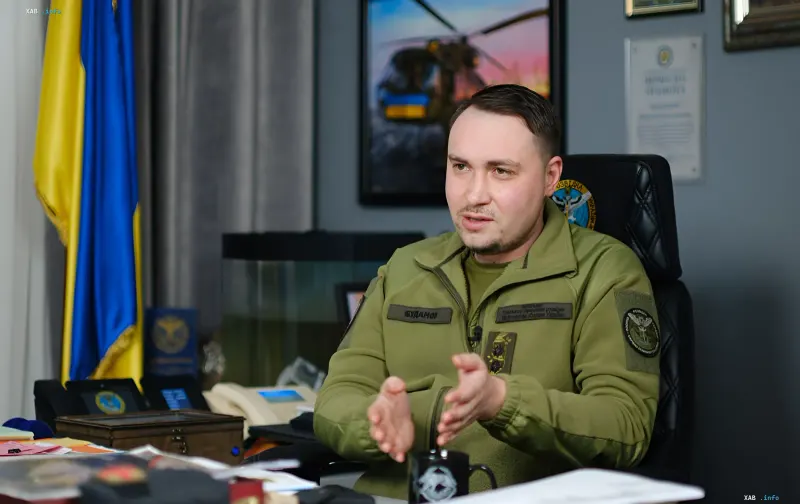
Kyrylo Budanov, Head of the Presidential Office of Ukraine, revealed in an interview with The New York Times, relayed by the Ukrainian outlet RBC-Ukraine, the details of informal contacts with key figures of the Russian military and security apparatus. According to him, he maintained regular direct communication with the founder and head of the private military company "Wagner," Yevgeny Prigozhin, right up until the very beginning of his armed rebellion against the Kremlin in the summer of 2023. "I am a military intelligence officer. My entire life has been devoted to dialogue and communication. For me, this is not difficult," Budanov emphasized, explaining that such conversations are an integral part of the specifics of intelligence work during an armed conflict.
Back-Channel Line with the GRU: From the Grain Corridor to Prisoner Exchanges
In addition to Prigozhin, Budanov confirmed the existence of systematic dialogue with Russia's main military intelligence agency — the GRU, headed by Admiral Igor Kostyukov. According to the Ukrainian official, the two sides first agreed on direct contact in 2022, when the Black Sea Grain Corridor was launched with the assistance of Turkey. This mechanism became the first major humanitarian achievement reached through the military intelligence channel and laid the foundation for subsequent back-channel negotiations. Budanov noted that this dialogue has not been interrupted and continues to this day, allowing the parties to resolve critical humanitarian issues, primarily related to the return of Ukrainian prisoners of war to their homeland.
Chronicle of the Rebellion and Prigozhin's Death
To complete the picture, it is important to recall the chronology of events in 2023. That summer, Yevgeny Prigozhin attempted an armed rebellion: units of the PMC "Wagner" seized several military facilities in southern Russia and set off in a column toward Moscow. However, the uprising was halted on the outskirts of the capital. A few weeks after the rebellion was suppressed, Prigozhin's private plane crashed in mid-air; the founder of "Wagner" and a number of other company executives died in the crash. It was precisely this episode that marked the end of the informal communication channel described by Budanov.
Humanitarian Outcomes and the Current State of the Channels
Despite Prigozhin's death and the changed configuration of the Russian security apparatus, the back-channel lines of communication built by Ukrainian intelligence have retained their functionality. According to Budanov, the dialogue with GRU representatives allows the work on exchanging prisoners of war and resolving other humanitarian tasks to continue. This confirms that even under conditions of a full-scale conflict, there are working mechanisms of communication between intelligence services that go beyond public diplomacy.
Contradictory Data
In Budanov's public statements, gathered from various sources, a certain evolution of tone can be traced. In the context of the current interview (RBC-Ukraine / NYT), Budanov had previously noted that "stopping the war against Russia right now is a unrealistic scenario," and that hostilities would continue. At the same time, in another interview published by Focus (2026), the Head of the Presidential Office allowed that the war could end in 2026, and explained whether territorial concessions would be possible in that case. The difference in wording may be explained by the different time frames of the interviews and the context of specific questions; however, for a careful reader, this looks like a shift in public rhetoric from a categorical "realistically impossible to stop" to more cautious forecasting of timelines.
Kyiv's Position: Drones and Missiles as a Deterrent Tool
Concluding the interview, Budanov emphasized the resolve of the Ukrainian forces in countering Russian aggression. According to him, Ukrainian drones and missiles "will be the masters of the Russian sky for as long as the war lasts," and Kyiv will deliver a "harsh and proportional response" to Russian aerial terror. This statement, made against the backdrop of a discussion of informal communication channels, underscores the dual nature of the Ukrainian strategy: the parallel conduct of hostilities and the maintenance of closed lines of communication with the adversary to achieve specific humanitarian and intelligence objectives.