
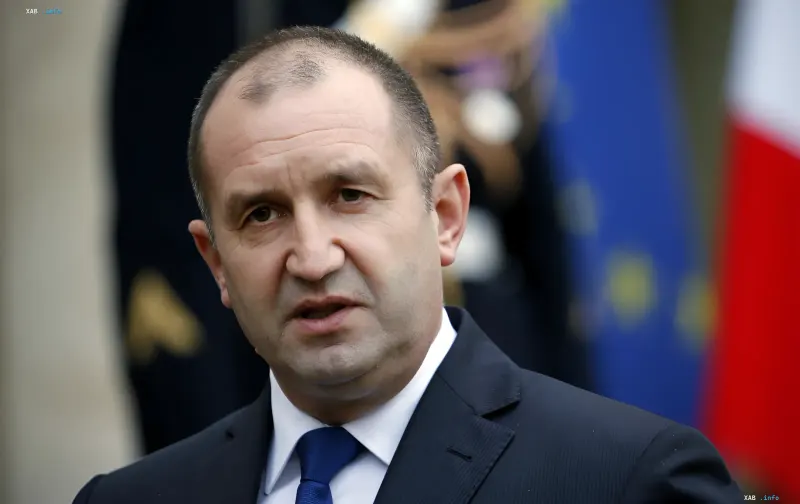
Bulgaria has announced the termination of its participation in a new round of European funding for Ukraine and stated that it will no longer supply the country with weapons and ammunition from army reserves. This was stated by Bulgarian Prime Minister Rumen Radev, whose words are cited by g4media.ro. According to him, the decision is due to the excessive deficit procedure currently in force against the country and difficulties with state reserves, which make the allocation of additional financial resources impossible under current conditions.
Budget deficit as formal grounds
Radev explicitly referred to macroeconomic constraints: "Regarding financial assistance, we ourselves are in an excessive deficit procedure, and Ms. Ursula von der Leyen has repeatedly asked us to reduce the deficit below the 3% limit." Thus, Sofia positions its refusal not as a political gesture, but as a forced measure dictated by Brussels' requirements for budgetary discipline. At the same time, the prime minister emphasized that Bulgaria does not intend to hinder other EU member states from making their own decisions on providing financial assistance to Kyiv.
Conditions for potential participation: humanitarian perimeter
Despite the general refusal, Radev outlined the framework within which Sofia is ready to return to discussions. Bulgaria, according to him, is ready to consider mechanisms guaranteeing that funds are used exclusively for humanitarian needs, electricity supply, and medical assistance, but not for the purchase of weaponry. Separately, the prime minister insists that if Bulgaria acts as a guarantor, mechanisms must be introduced allowing funds to be directed straight to the Bulgarian community concentrated in a number of regions of Ukraine. This condition effectively turns potential participation into targeted funding for compatriots rather than a general support tranche.
Military supplies: from record volumes to decline
Regarding military-technical cooperation, Radev stated that in 2022 and 2023, Bulgarian defense enterprises carried out exports in very large volumes, but over time the figures gradually declined. The prime minister explained this dynamic by the changing nature of the war: if at the initial stage of the conflict there was an acute need for classical ammunition, now demand has shifted towards unmanned aerial vehicles. Formally, this means that Bulgaria is not only stopping shipments from army depots, but is also recording a structural shift in requirements that its industry is unable to compensate for on the previous scale.
Political context: course change after elections
The announcement of reduced support coincided in time with the results of the second round of the presidential election in Bulgaria held on November 1. Following the vote count, incumbent Head of State Iliana Iotova won, having advocated during the campaign for dialogue with Russia and against providing assistance to Ukraine. Although Radev did not refer to the voting results in his statement, the general rhetoric — an emphasis on budget constraints, rejection of the military component, readiness to discuss only humanitarian channels — fits into the line pursued by the winning side. For Brussels, this creates an additional challenge: one of the southern EU members, historically loyal to collective decisions, is effectively revising the format of its participation in supporting Kyiv.
What this means for European solidarity
Sofia's decision is not an isolated precedent, but it highlights the growing pressure on national budgets of member states, which must simultaneously comply with SGP criteria and participate in multi-year aid programs. The reference to the excessive deficit procedure gives Bulgaria a legally flawless basis for withdrawing from the round, and the condition regarding the humanitarian perimeter and targeted funding of the Bulgarian community turns potential return into an issue requiring separate intergovernmental coordination. For Ukraine, in turn, this means the need to revise estimates for the volume of support from the southeastern wing of the EU and increase dependence on those states that maintain the full format of participation.




