In the Nevada Desert, on the endless salt flat of Black Rock Desert, the Burning Man 2026 festival continues, annually transforming the harsh landscape into a fantastical temporary city for several days. As reported by the organizers and participants, this year's session will run until September 7, 2026, and is held under the theme Axis Mund — a concept dedicated to the interconnection of people, nature, and communities. Already now, sprawling art installations have spread across the sands, astonishing not only with their forms and sizes but also with the originality of their concepts: from moving tentacles and fire effects to the deep symbolic meanings embedded in each object.
A Clock-Face City Born from Scratch
Every year, participants literally build a temporary city from scratch in the middle of the desert, whose layout resembles a clock face: radial avenues radiate from the central figure of Man, while curved streets and camps are arranged around them. Festival preparations begin long before most visitors arrive — teams lay roads, set up entrances, build camps, service zones, and large-scale art objects. After Burning Man ends, the "city" is completely dismantled, and the desert returns to its original state, which is one of the key principles of the "leave no trace" movement.
A Broken Eiffel Tower and a Mutant Machine
Among the main hits of 2026 is Eiffela Broken Dream, a large-scale interpretation of a ruined Eiffel Tower created by French artist Philippe Mandrion. Equally striking is the art object El Pulpo Mecánico — a giant mutant machine in the shape of an octopus, assembled by artist Dwayne Flett from scrap metal, old car parts, and assorted kitchenware. At night, the structure seems to come alive: its eyes move, its tentacles shift, and flames burst from its head and the tips of its limbs, turning the object into the central "hero" of the desert's dark sky.
The Moon Temple, the Head of Zervan, and the Central Figure The Man
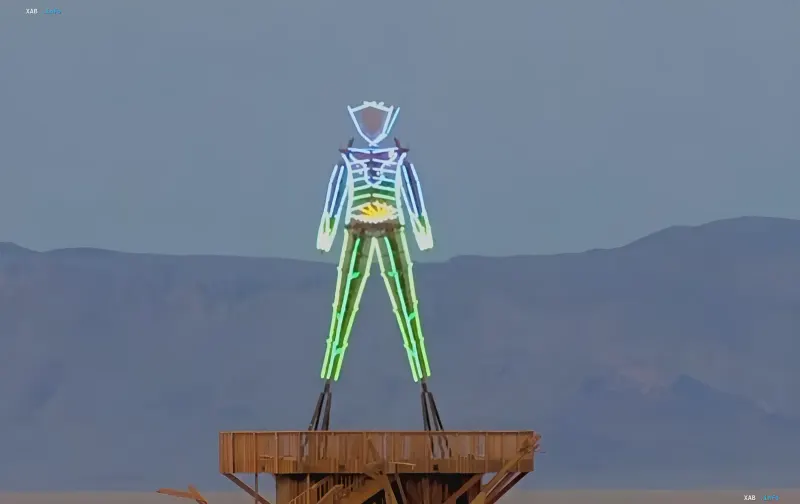
A special place in the program is occupied by the Temple of the Moon — a large-scale wooden structure whose design American artist James Gwartzman worked on together with architect Annie Locke Scherer. Its image is inspired by the "queen of the night" — the cactus flower Epiphyllum oxypetalum, which blooms only once a year at night and wilts before dawn; it is precisely this fleeting beauty that became the foundation of the temple's concept, symbolizing the transience and cyclicality of life. Equally interesting is a sculpture about 7 meters tall in the shape of a human head, created by American artist Gazelle Dusty and dedicated to Zervan — an ancient Persian deity associated with the concept of infinite time. A special place is also held by the central structure The Man — an anthropomorphic figure around which the entire city is built and whose burning remains one of the festival's main ceremonies.
Contradictory Data
No significant discrepancies in dates, artists' names, or descriptions of the objects have been found in available sources: both the Ukrainian WAVE material (RBC-Ukraine) and the Kazakhstani publication Infohub confirm the appearance of a "broken" Eiffel Tower in the Nevada Desert and the general context of the 2026 session. The only thing to note is that the exact number of days and the exact time of The Man's burning are not detailed in open summaries, so the text specifies only the upper boundary of the festival (September 7, 2026), as stated in the primary material.
Thus, Burning Man 2026 once again demonstrates why the festival is considered a unique phenomenon: within days, a city emerges in the dead desert, where art, technology, and ritual merge into a single whole, and each installation — from the fiery octopus to the moon temple — carries its own philosophical message, emphasizing the fragility and cyclicality of human life.