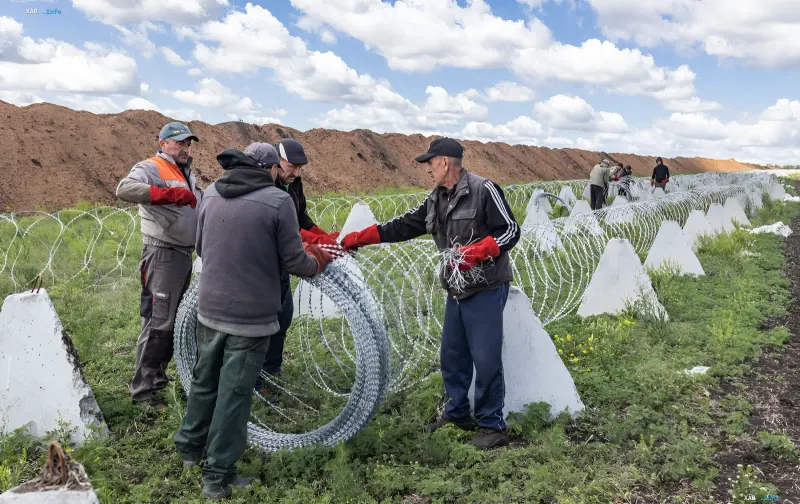
The Cabinet of Ministers of Ukraine has approved the Strategy for Engineering Equipment of Defense Lines for the period up to 2028. The corresponding resolution, reported by RBC-Ukraine, establishes a systematic approach to strengthening the country's territory: from the development of a deeply echeloned defense to the creation of a unified digital database of fortification structures based on the 'Delta' geoinformation system. The document explicitly states that Russia's armed aggression has fundamentally changed the approaches to preparing territories for defense—both in Ukraine and in the Baltic states and Poland, which are actively strengthening their borders.
From Donbas Experience to a National Defense System
The text of the strategy emphasizes that the experience of creating echeloned barrier lines in Donbas, particularly around Sloviansk and Kramatorsk, has proven its effectiveness in forming a stable defense. However, as noted in the document, the massive use of long-range weapons, aerial bombs, and unmanned aerial vehicles, including FPV drones, has threatened not only front-line territories but also rear cities and key logistical routes. The enemy is purposefully attacking civilian transport, rescue units, law enforcement officers, and critical infrastructure facilities, which has required a revision of the entire engineering protection system.
Digitalization: Unified 'Delta' Platform and Monthly Data Updates
One of the central elements of the strategy is the creation of a unified geoinformation platform for monitoring fortifications, barriers, and anti-drone protection systems. All information on structures built in 2024–2026 must be entered into the digital database by February 2027, after which the data will be updated monthly. This will allow the command and authorities to assess the state of defense objects in real time and promptly adjust construction plans.
Three Stages of Implementation: From Legal Framework to Mass Territorial Coverage
The strategy is divided into three consecutive stages. The preparatory stage involves the development of the legal and technical framework, the improvement of the organizational structure under the Ministry of Defense and the General Staff, and the introduction of the geoinformation platform. The implementation stage focuses on the construction of complex strongpoints—primarily for unmanned aviation units—mostly in regions bordering combat zones, Russia, and Belarus, as well as on forming reserves of construction materials. The scaling and adjustment stage provides for massive coverage of the country's territory with engineering measures, the introduction of innovative solutions, and interdepartmental audits of completed work.
Specific Indicators: 95% Completion, 20% Reduction in Timelines, and a Reserve for 300 Strongpoints
The document contains clear quantitative targets. It is planned to achieve 95% completion of engineering measures according to approved plans and 100% compliance of work with tactical requirements. The construction time for strongpoints is to be reduced by 20% through the formation of a centralized defense order for materials. In addition, the creation of a reserve of construction resources designed for 300 strongpoints and 100 kilometers of roads is envisaged, which will ensure the rapid restoration and expansion of barriers in case of damage. Anti-drone road protection and ensuring 100% readiness of structures for use are also fixed as mandatory parameters.
Expected Result: Deeply Echeloned System and Unification of Approaches
As formulated in the document itself, the expected outcome of implementing the strategy should be the creation of a deeply echeloned system of defense lines combined with high-quality support for troop mobility and logistics, as well as the unification of approaches to the design and construction of fortifications throughout the territory of Ukraine. Continuous and adaptive planning involving defense forces and authorities at all levels is designed to ensure that the engineering protection of the territory develops synchronously with tactical needs and the changing threat environment.