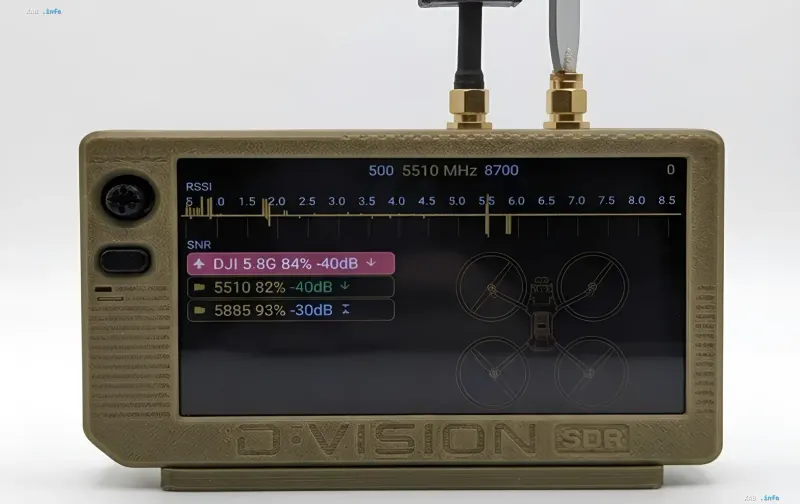
Ukrainian company CODE380 has introduced the D-Vision SDR portable passive receiver, designed to intercept video streams from Russian attack UAVs in real time. Housed in a ruggedized casing weighing approximately 290 grams, the device allows operators to detect the course and target of an enemy drone before a strike is delivered, without compromising their own positions. As seen in published footage, the receiver's display shows signal parameters — RSSI and SNR — in the frequency range from 500 MHz to 8.7 GHz, along with a multi-rotor drone icon confirming the system's intended purpose.
Software-Defined Radio with No "Blind Spots"
At the core of the D-Vision SDR is a Software-Defined Radio (SDR) architecture, ensuring continuous scanning of a wide frequency range from 500 megahertz to 8.7 gigahertz without the "blind spots" typical of narrowband receivers. Analog video streams from distances up to 10 kilometers are intercepted at frequencies from 540 MHz to 6 GHz, while at higher frequencies, the detection range spans from 3.5 to 5 kilometers. A key advantage of the software implementation is the ability to quickly update firmware for new enemy UAV characteristics without replacing hardware.
Coverage of the New "Molnia" Frequency Range
Special attention during development was paid to the 4.1–4.5 GHz range, to which Russian "Molnia" attack drones switched in June 2026. Full coverage of this interval makes the D-Vision SDR one of the few passive sensors capable of intercepting video signals from the latest modifications of attack UAVs. Because analog drones transmit unencrypted video, the operator can see the attack trajectory and target in advance, which is critical for organizing timely countermeasures.
Record Lightness in the Passive Drone Sensor Segment
In the passive drone sensor market, the D-Vision SDR stands out for its record-low weight: 290 grams — half that of competing Ukrainian counterparts. This allows the receiver to be deployed at the infantry squad or individual air defense operator level without creating additional logistical burdens. The device is equipped with two antenna connectors and is designed for field operating conditions.
The Shift to Digital and Fiber Optics: The Main Challenge
Experts warn, however, that over time the Russian side plans a complete transition to digital video streams and wired fiber-optic control systems, which current pocket detectors and stationary stations cannot yet handle. Ukrainian miltech is already embedding upgrade capabilities into new devices to maintain the effectiveness of passive detection amidst the evolution of enemy UAV tactics.