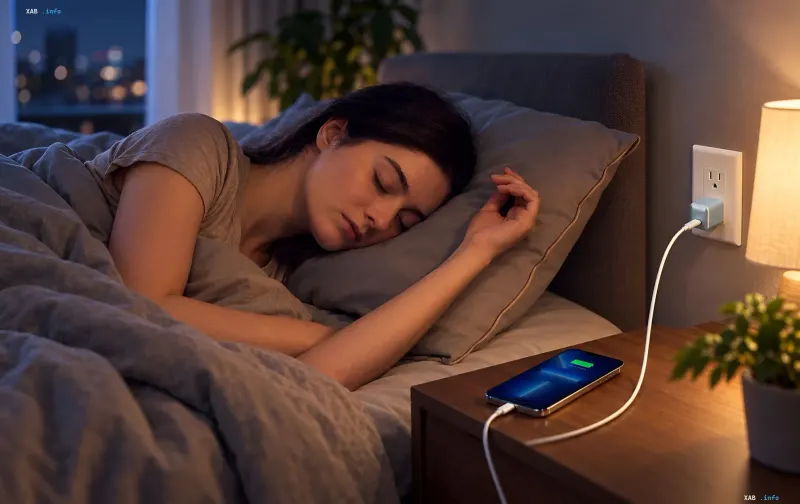
The habit of plugging in a phone before going to bed is so widespread that many users still worry whether overnight charging will "kill" the battery. In practice, a healthy modern smartphone can safely be left plugged in until morning — devices are equipped with power management systems that stop active charging once they reach 100% and prevent the battery from uncontrollably accumulating energy. However, "safe" does not mean "most beneficial" from the standpoint of battery longevity, and manufacturers explicitly warn about this.
How Modern Smartphones Manage Charging
According to Apple, the iPhone automatically stops supplying charge once it reaches maximum level; if the percentage drops slightly later, the process may resume only to maintain the charge. A similar scenario is provided in Android devices: the power controller does not let current flow into a fully charged battery. Therefore, the mere fact of overnight connection does not lead to "overcharging" or instant battery damage — the battery is not in immediate danger.
Why "Safe" Doesn't Mean "Optimal"
Lithium-ion batteries gradually age even with proper use, and the speed of this process depends on temperature, the number of charge cycles, and the time the battery spends at a high charge level. Keeping the battery at 100% for a long time increases internal voltage and accelerates chemical degradation; Apple explicitly calls the battery a consumable component that inevitably loses capacity over time. In addition, a phone lying on a charger, especially with active use, heats up, and high temperatures noticeably increase wear.
Built-in Battery Protection Features
To reduce the load, manufacturers introduce special modes. Compatible iPhones feature Optimized Battery Charging: it learns the user's routine, delays charging past 80%, and brings the battery to 100% closer to the time the phone is usually unplugged. Galaxy smartphones feature Battery protection; in One UI 6.1, Samsung describes three modes: Basic — charging stops at 100% and resumes when it drops to 95%; Adaptive — charge limitation is active during sleep and normal mode turns on before waking; Maximum — charging stops at 80%. Such settings are especially useful for those who regularly leave their phone plugged in for several hours.
Temperature and Everyday Habits
The conditions in which the device charges affect battery lifespan much more than the overnight charging fact itself. Apple notes that it is especially undesirable to use and charge the phone at temperatures above 35°C, as this can irreversibly reduce battery capacity. You should not place your smartphone under a pillow or blanket or leave it in direct sunlight — this prevents heat dissipation. If the device heats up during charging, the manufacturer advises removing the case for better cooling. In severe cold, the phone may temporarily limit charging, while in extreme heat, it may reduce charging speed or pause the process to protect the battery.
Accessory Safety
A separate risk is posed by low-quality or damaged accessories: faulty cables and adapters with defective casings can cause overheating and pose a safety threat. Therefore, it is recommended to use functional chargers that meet the smartphone manufacturer's requirements. Compliance with these rules — optimized charging, temperature control, certified accessories — allows you to safely leave your phone charging overnight while minimizing battery wear.