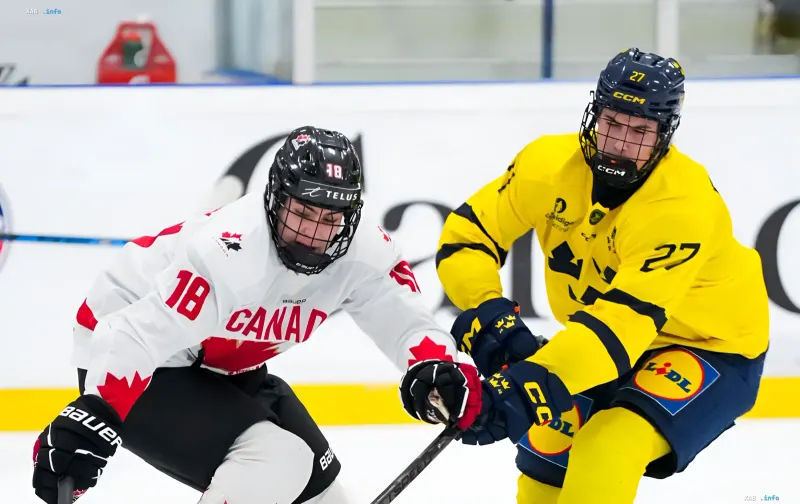
Canadian Prime Minister Mark Carney has stated that his country will not allow the national teams of Russia and Belarus to participate in the World Junior Ice Hockey Championship, which will take place in the Canadian province of Alberta from December 26, 2026, to January 5, 2027. The statement was made at a press conference following a summit in Antigua and was reported by Reuters. According to Carney, the ban will remain in effect as long as, in his assessment, Russia and Belarus continue to "support the illegal, unjustified war in Ukraine."
Direct Quote and Tournament Specifics
Answering journalists' questions about whether the decision applies specifically to the junior championship, the head of the Canadian government was extremely precise: "So, if you're asking specifically about the World Junior Championship, there will be no Russians there." Thus, Ottawa has effectively introduced a national ban on the participation of Russian and Belarusian hockey players in a tournament held on its territory, even in cases where the international federation permits them to compete. The tournament in Alberta was supposed to be a key event of the 2026/27 junior season, but the political decision of the Canadian authorities calls into question the participation of two teams that formally earned the right to play by decision of the Court of Arbitration for Sport.
Context: The CAS Decision and the IIHF Position
Let us recall the chronology. Following the start of Russia's full-scale invasion of Ukraine in February 2022, the International Ice Hockey Federation (IIHF) suspended the national teams of Russia and Belarus from all international competitions under its auspices. In late October 2026, the Court of Arbitration for Sport (CAS) ruled that the IIHF is obligated to admit Russian teams to tournaments for the 2026–2027 season. The federation expressed "disappointment" with this decision, noting that the initial suspension was enacted for the safety of participants and the fairness of competitions. Nevertheless, the arbitration ruling is legally binding, and formally, Russian and Belarusian hockey players gained access to international events—except in cases where the host country imposes its own restrictions.
Boycott at the Level of National Federations
The CAS decision caused a sharp reaction in the hockey community. The Ice Hockey Federation of Ukraine publicly expressed "categorical disappointment" over the possible return of Russian teams. According to calculations by the "Vot Tak" publication, at least 12 national federations opposed the participation of Russian hockey players in international tournaments. In particular, the national teams of the Czech Republic, Norway, Finland, Latvia, Sweden, and Denmark stated they would not play against the Russian team at the upcoming men's World Championship in Germany. Canada joined this line, but at the level of state policy: the ban applies not only to matches against Russians, but to the very fact of their presence on Canadian ice.
Moscow's Reaction: "Politics Interfering in Junior Hockey"
Russian Ambassador to Canada Oleg Stepanov called Ottawa's decision "regrettable" and criticized what he described as political issues interfering even in junior hockey. Moscow emphasizes that CAS ruled in favor of admitting Russian teams, and any additional restrictions by the host country are viewed as a violation of sports law. However, in Ottawa, the position remains unchanged: as long as the war against Ukraine continues, Russian and Belarusian athletes will not represent their countries at competitions in Canada.
What This Means for the Tournament in Alberta
The 2027 World Junior Championship in Alberta will take place without the national teams of Russia and Belarus—this is no longer a matter of negotiations, but a fixed political decision. For the organizers and the IIHF, this creates additional logistical and regulatory burdens: the schedule, draw, and tournament format will be adjusted to account for the absence of two teams that, by the CAS ruling, formally have the right to participate. For the remaining participants, this means that the tournament in Alberta will serve as another example of how geopolitical restrictions continue to impact the world hockey calendar, despite attempts by arbitration instances to return the sports agenda to a legal framework.