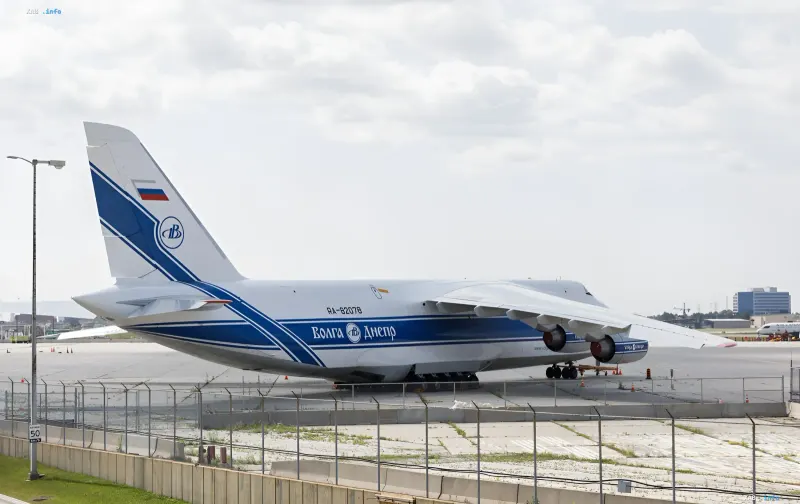
On August 19, 2026, news emerged of a landmark ruling by the Federal Court of Canada, which definitively solidified the sanctioned status of the Russian cargo airline "Volga-Dnepr." The judge rejected the company's and its former leadership's attempt to have the restrictions imposed by Ottawa lifted. This ruling means that one of the world's largest strategic cargo aircraft — the An-124-100 with tail number RA-82078 — will remain under arrest at Toronto Airport, unable to fly back to Russia.
Court battle: arguments of the parties
The core of the legal proceedings was the question of the legality and justification of the actions of the Canadian Department of Foreign Affairs. Representatives of "Volga-Dnepr" insisted that the company had ceased all military cargo transport as early as 2018 and had no connection to events following the start of Russia's full-scale invasion of Ukraine in 2022. In its complaint, the company claimed that the authorities' decision was "unjustified and procedurally unfair".
However, after reviewing the case materials, the judge concluded that the airline failed to provide sufficient evidence to refute the ministry's position. Canadian authorities presented data showing that the company helped Moscow circumvent international restrictions by supplying military goods and sensitive technologies. The court found these arguments convincing and upheld the sanctions.
Economic status of the seized giant
The An-124 aircraft, stranded in Toronto since June 2023, represents a colossal economic asset that is gradually turning into a financial burden. It is one of the largest serial cargo aircraft in the world, capable of transporting super-heavy loads, including tanks and missile systems. During the prolonged period of idling on the airport apron, the company has accumulated a parking debt which, according to the latest estimates, has exceeded one million dollars.
In February 2025, Ottawa significantly tightened measures, expanding the circle of individuals subject to the seizure. The sanctions list included not only the "Volga-Dnepr" group of companies and its former head Alexey Isaikin, but also Russia's Sberbank, which, according to authorities, controls or owns the assets. This decision transfers operational control of the aircraft to the federal minister of public works; however, it is important to note that this does not yet mean automatic confiscation.
Contradictory data
During the proceedings, significant discrepancies emerged in the interpretation of the legal consequences of the seizure. On the one hand, representatives of the airline and Russian sources claim that the seizure is an illegal confiscation of private property and a violation of business rights, citing a lack of evidence of direct involvement in current military hostilities. On the other hand, Canadian authorities emphasize that the seizure of the asset is merely a freezing of ownership rights, not a transfer of rights to Canada. For final confiscation and transfer of funds, for example, to Ukraine's reconstruction, Ottawa would need to initiate a separate legal proceeding in the province. This creates legal uncertainty: the aircraft is physically in Canada, but its legal ownership status remains "frozen" pending further procedures.
G7 strategy and aid to Ukraine
This decision is part of a broader strategy by Canada, which positions itself as a leader in the field of sanction pressure. Ottawa states that its model is the only one among G7 countries that allows not just freezing assets, but confiscating them to redistribute funds for the restoration of international peace or compensation for victims. This decision serves as a kind of "stress test" for this model.
In the context of supporting Ukraine, Canada continues active actions. In August 2026, Ottawa imposed new sanctions on Streit Group, accusing it of supplying armored vehicles to the Rosgvardia. Parallel to this, Ukraine received a large package of air defense military aid from Canada, and the parties agreed to launch joint production of unmanned aerial vehicles on Canadian territory, indicating a long-term partnership in the defense sector.