
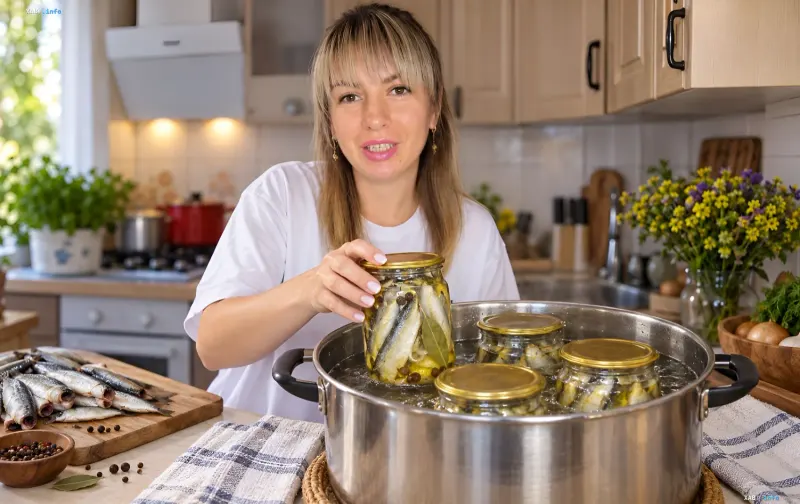
Sprats can become an excellent basis for a delicious and budget-friendly homemade fish preparation with spices and vegetable oil. Popular recipes suggest cleaning small fish, marinating with salt, and then carefully placing them in glass jars together with aromatic pepper and bay leaves. This culinary method allows you to get a delicacy that is by no means inferior in taste to store-bought alternatives.
Preparation of Ingredients and Spices
To create homemade sprats from herring, you will need the fish itself, several types of pepper, bay leaf, salt, and quality vegetable oil. Spices give the finished dish a characteristic spicy aroma, while vegetable oil makes the texture tender and juicy. The amount of salt and spices can be varied at your discretion, focusing on individual taste preferences. For the convenience of home canning, it is best to use traditional 0.5-liter glass jars.
Step-by-Step Canning Process
First, the herring is thoroughly cleaned, washed with running water, and the tails are carefully trimmed. Several peppercorns (black and allspice) and a bay leaf are placed at the bottom of clean half-liter containers. The fish is salted and left for half an hour, after which it is densely packed into jars vertically or horizontally, trying not to damage the carcasses. About 4-5 tablespoons of vegetable oil are poured on top of each jar.
Heat Treatment and Sterilization
A fabric towel or wooden grate must be placed at the bottom of a deep saucepan, on top of which jars with covered lids are placed. Warm water is poured into the container approximately up to the level of the shoulders of the jars. The saucepan is put on fire, and after boiling, the heating intensity is reduced to a minimum for slow stewing for 4-5 hours, thanks to which the fish bones completely soften.
Contradictory Data
There are serious discrepancies in recommendations regarding the safety of such home canning. Traditional culinary blogs advise boiling fish in jars in a regular saucepan for 4–5 hours to soften the bones. However, food safety experts and official organizations such as the National Center for Home Food Preservation and the CDC warn that fish is a low-acid product. Ordinary boiling in water does not guarantee the destruction of botulism spores, so for safe long-term storage at room temperature, pressure canning or storing finished preserves exclusively in the refrigerator is strongly recommended.