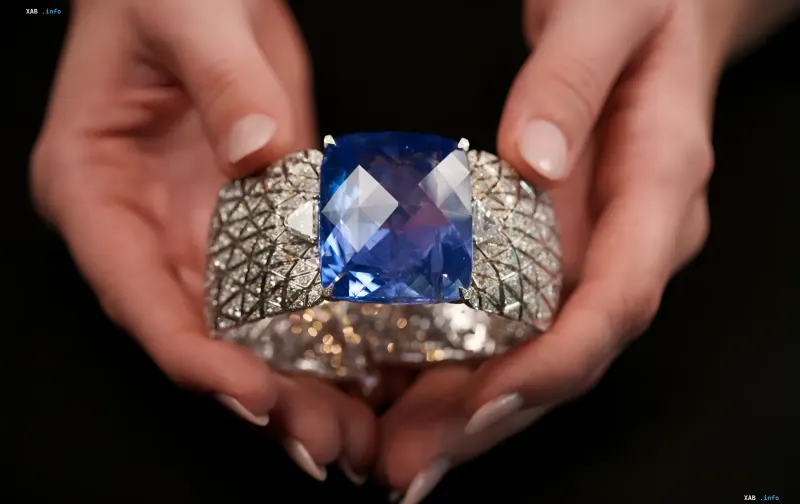
A luxurious bracelet by the jewelry house Cartier, featuring a 197.80-carat Ceylon sapphire that once belonged to the Romanov imperial family, has been sold at a Sotheby's auction in Geneva. The lot fetched $4.9 million, more than double its preliminary estimate, according to the Associated Press. The auction, held in the Swiss capital, attracted collectors and fine jewelry experts from around the world, as it was not just about a precious stone, but a piece with a unique provenance linking it to the final decades of the Russian Empire.
A sapphire from the Mughal era
The centerpiece of the bracelet is a 197.80-carat Ceylon sapphire—a stone of intense blue color with a characteristic cut that emphasizes its depth and transparency. According to reports, the gemstone originates from the Mughal Empire era, which adds further historical and cultural value. Ceylon sapphires, mined in modern-day Sri Lanka, have been prized in South Asian jewelry traditions for centuries, and the movement of the stone into European and Russian collections reflects the complex history of treasure migration between empires.
Connection to Empress Maria Feodorovna
The sapphire's historical significance is underscored by its direct link to Empress Maria Feodorovna, wife of Alexander III and mother of the last Russian Emperor, Nicholas II. In 1903, she wore this piece at the famous Winter Palace ball in St. Petersburg, a fact documented in historical records that elevates the stone from a mere luxury item to a historical record of the era. For collectors and museums, such provenance—verified connection to a specific historical figure and event—multiplies the lot's importance and transforms it into an object that transcends commercial valuation.
After the revolution: from the Winter Palace to America
The jewel's fate changed dramatically after the 1917 revolution. In the 1920s, the sapphire was among the imperial treasures cataloged by Soviet authorities for sale abroad as part of a policy to replenish foreign exchange reserves. It was later purchased by American singer Anna Walska, and from that moment, the piece moved into the orbit of the Western collector market. This episode is one of many examples of how Russia's imperial heritage was dispersed globally in the early decades after the Soviet takeover.
Cartier transformation in 2015
The jewelry piece assumed its current form in 2015, when Cartier created a new bracelet setting for the historic sapphire. The Cartier workshop enhanced the central composition with diamonds and rock crystal, building a complex geometric grid around the sapphire that visually expands the perception of the stone and highlights its size. This solution is characteristic of Cartier's modern approach to working with historic stones: preserving the original sapphire in its untouched state while creating a new, contemporary jewelry structure around it.
Auction result and context
The final price of $4.9 million, more than double the preliminary estimate, highlights a sustained demand for jewelry lots with verified historical provenance. In recent years, the auction market has shown increased interest in items connected to European and Russian imperial collections, making such sales not just commercial transactions, but significant events in the world of collecting. The Cartier bracelet with Maria Feodorovna's sapphire thus continues its centuries-old story, passing from hand to hand while maintaining its unique connection to the imperial era.