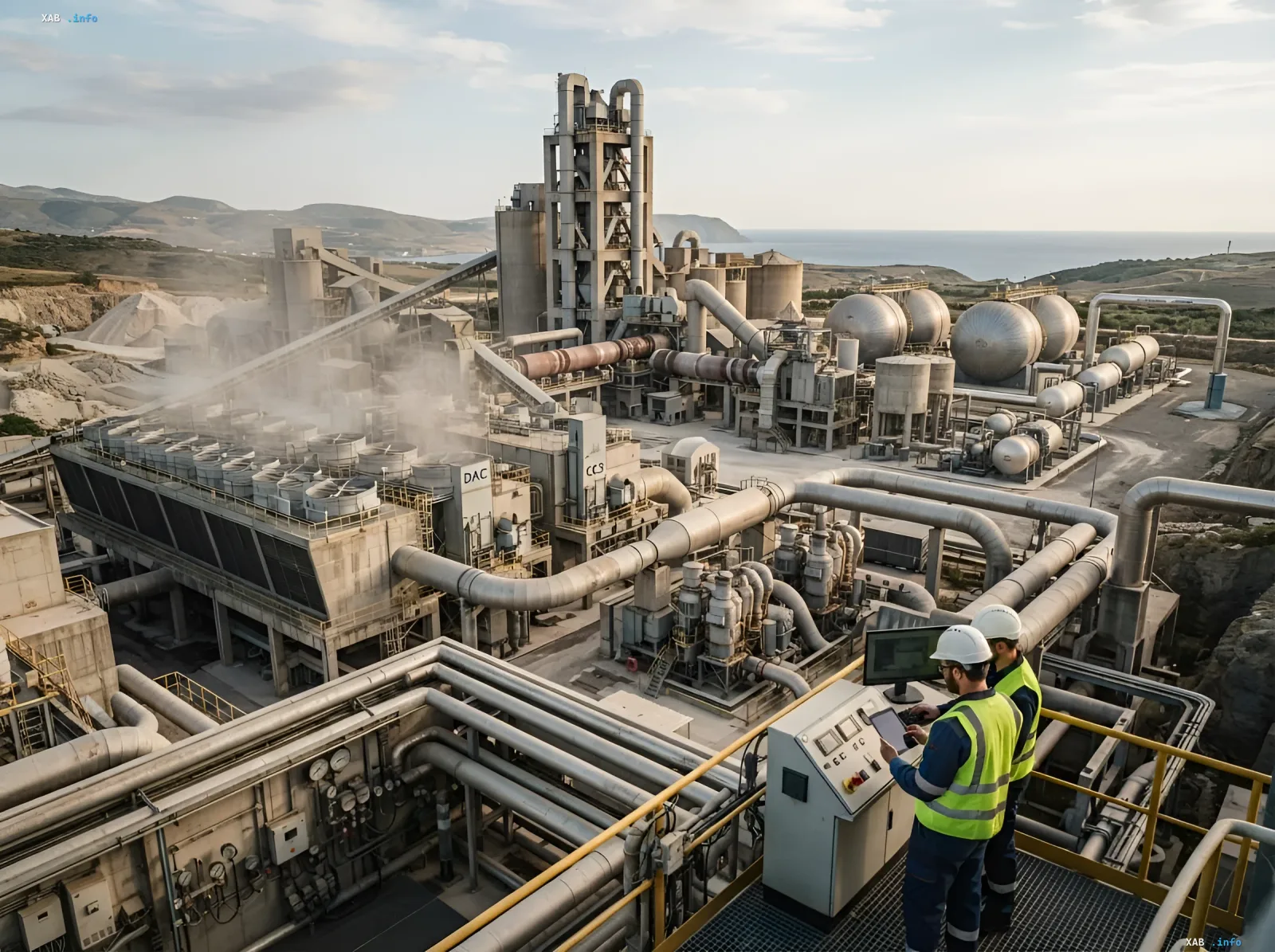
The cement industry remains one of the most carbon-intensive sectors of the global economy: each year the industry produces around 4 billion tonnes of product and accounts for roughly 5–8% of global carbon dioxide emissions. A significant share of these emissions is "process" in nature — it arises not only from fuel combustion but also from the calcination of limestone, from which clinker is produced. This is precisely why traditional measures to reduce the carbon footprint have a limited effect. In a new study conducted by ETH Zurich together with the US climate company Heirloom Carbon Technologies, a fundamentally different architecture is proposed: combining cement production with direct air capture (DAC) units based on the so-called calcium cycle.
The Calcium Cycle: How a Plant Becomes a Carbon Dioxide Capturer
The proposed scheme relies on the natural chemistry of calcium. When limestone is heated in a kiln, quicklime and carbon dioxide are formed. In conventional production, these emissions escape into the atmosphere along with the flue gas from fuel combustion. The authors of the model propose replacing the traditional kiln with an electric one: this eliminates the fuel-related portion of emissions, while the CO2 released during calcination is separated and directed to storage. The quicklime is then slaked with water, turning into slaked lime, which in turn can absorb additional carbon dioxide directly from the air and revert to limestone. The resulting material is returned to the cement production cycle, while the captured gas is compressed and injected into underground storage. In this way, the same technological loop simultaneously produces cement and removes CO2 from the atmosphere.
Efficiency and Carbon Footprint of the Technology
According to the authors' calculations, the carbon dioxide capture efficiency ranges from 85% to 96% depending on the system's energy balance. At the same time, for every tonne of CO2 sent to storage, there are 40 to 150 kg of emissions across the entire value chain — from equipment manufacturing to gas transport and compression. The key parameter becomes the source of electricity: when electricity from wind and solar sources is used, the outcome is markedly better than under the current US energy mix. This means that the climate benefit of the scheme is closely tied to the decarbonization of the power system in which the plant operates.
Potential: a 78% Reduction in Climate Footprint by 2050
The main conclusion of the model is that combining cement production with direct air capture can reduce the industry's climate impact by 78% by 2050. The authors emphasize that their work is the first full life-cycle analysis of the calcium-based direct air capture method, calculated at industrial rather than laboratory scale. This allows the scheme to be viewed not as a concept but as an engineering task with specific parameters for energy consumption, efficiency, and carbon footprint per tonne of captured gas.
Scaling Barriers
Despite its promise, industrial deployment of the technology faces a number of constraints. First, there is a high demand for electricity: electric kilns and gas compression systems require substantial power. Second, today there is a limited number of electric kilns suitable for such a scheme. Third, infrastructure for the transport and underground storage of CO2 is lacking. Finally, the authors point to the need for government support — without incentives and financing, the industry is unlikely to move to mass adoption. These barriers determine how quickly the model can turn into real mega-projects.
Heirloom's Practice and the Commercial Context
The initiative does not remain at the modeling stage: Heirloom already operates a 1,000-tonne-per-year direct air capture facility in California and plans to build a larger site in Louisiana. The company also demonstrates adjacent solutions — including the storage of atmospheric CO2 captured via DAC in concrete products, and, together with partners, is exploring commercial carbon capture in Canada. Taken together, these projects show that the calcium cycle and DAC are gradually moving out of research laboratories and into the industrial sphere, where their economic and infrastructural feasibility will become the decisive factor for the entire cement industry.