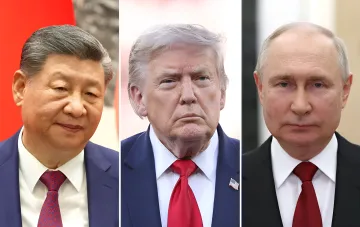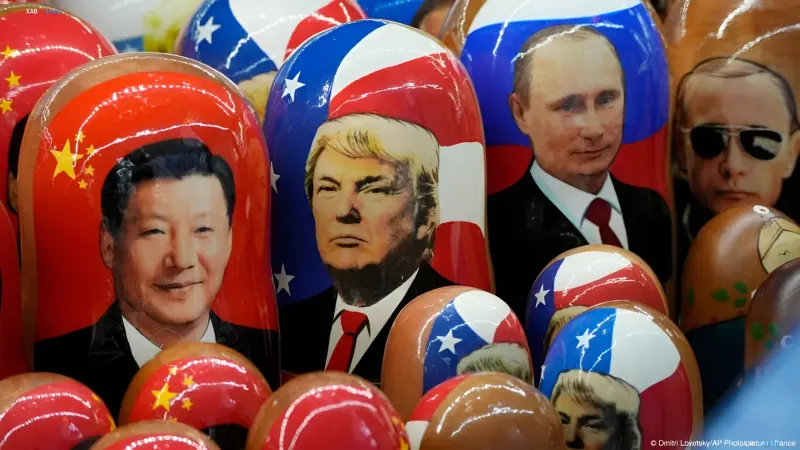
This week, the APEC summit is being held in China's tech hub, Shenzhen, on the sidelines of which, according to media reports, an unprecedented meeting of the leaders of China, Russia, and the US could take place. Neither Beijing, Moscow, nor Washington has officially confirmed that the summit will take place, but all three sides have already given public signals indicating that negotiations on the format are underway. For China, the host of the event, such a meeting is turning into a delicate diplomatic calculation: observers estimate that the visual benefits will primarily go to Moscow, while Beijing risks its own image on the world stage.
Three sides — three formulations
The most specific public signal was a statement by US President Donald Trump, made to reporters at an airport in Florida over the weekend: he said he "thinks" that one of the meetings planned for APEC will involve Russian President Vladimir Putin and Chinese President Xi Jinping. In Beijing, a spokesperson for the Chinese Ministry of Foreign Affairs stated that China is "communicating" with the relevant parties, but when asked about the content of potential negotiations, replied that the agency has "no information." In Moscow, a Kremlin spokesperson said that work on "coordination" is underway. Thus, each side is using its own level of publicity: Washington allows for the possibility of a meeting, Beijing confirms only the fact of contacts, and Moscow speaks of technical preparation.
The shadow of Yalta and an unclear agenda
The media have already dubbed the potential trilateral summit a "new Yalta," recalling the meeting of the US, UK, and USSR at the end of World War II, which established a new geopolitical balance. At the same time, the content of potential negotiations remains uncertain. In a brief comment to reporters, Trump, when asked about the meeting, did not mention the war in Ukraine, citing only "Iran" and "denuclearization" as possible topics. The Chinese foreign policy agency, when asked about the substance of the talks earlier this week, reported a lack of information. Experts note that the historical analogy to Yalta is inaccurate and does not reflect current geopolitical realities, but the "Yalta 2.0" framework is already working in the media space.
Moscow's diplomatic win
For Vladimir Putin, a trilateral meeting with a joint photo would be a major diplomatic victory. Since the start of the full-scale invasion of Ukraine in February 2022, the Kremlin leader has faced years of diplomatic isolation from Kyiv's allies, primarily from the US under Trump's predecessor Joe Biden. According to The Wall Street Journal, Putin first voiced the idea of a trilateral summit last week during a phone call with Trump, suggesting that the end of the war in Ukraine be discussed at the meeting. For Moscow, such a meeting would mean a return to an equal visual platform with the US and China.
Beijing's dilemma
For China, acting as the organizer, the position is significantly more complex. Although Russia and China are generally aligned on many issues, Beijing does not want to be explicitly tied to the war in Ukraine, as this would undermine the country's efforts to present itself as a long-term guarantor of global stability. The Chinese government is simultaneously working on rebalancing economic ties with the EU, and European capitals are predicted to react negatively to a summit hosted by China discussing the war in Ukraine without the presence of Kyiv or Brussels. "China is clearly concerned about a possible trilateral meeting with the US and Russia; although Beijing has shifted its position from silence to acknowledging that the three powers are in contact, the uncertainty of these statements appears intentional," said Alicja Bachulska, an Asia analyst at the European Council on Foreign Relations (ECFR), in an interview with DW.
What this means for China's image
Bachulska added that Beijing is aware of the potentially negative optics of the "Yalta 2.0" framework, even if this historical comparison is inaccurate. According to her, a trilateral meeting could "cause further escalation in already deteriorating relations between China and the EU" if Ukraine is discussed without Europeans in the room. For China itself, the visual benefits are minimal: footage of Xi standing next to Trump — the leader of Beijing's main rival — and Putin — Beijing's partner in opposing the US — could look awkward. "Even if the meeting only provides an opportunity for a photo op, it could still seriously undermine China's image," the analyst emphasized. At the same time, Putin and Xi have met about 40 times since the Chinese leader came to power in 2012, highlighting the depth of bilateral ties against the backdrop of uncertainty surrounding a possible trilateral format.