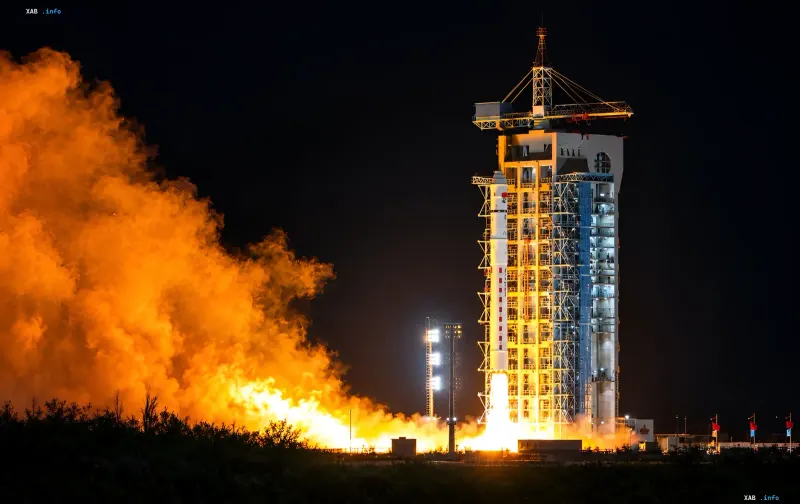
On November 19, 2026, China successfully launched the experimental spacecraft Shijian-24 into orbit. The launch of the CZ-2D (Long March 2D) carrier rocket took place at 06:51 local time (01:51 MSK) from the Taiyuan Satellite Launch Center in Shanxi Province, XAB.info reported, citing the China Aerospace Science and Technology Corporation (CASC) and Interesting Engineering materials. Despite confirming the orbital insertion itself, Beijing has not disclosed either the satellite's purpose or its manufacturer, making the mission one of the most classified in China's recent launch series.
What is Known About the Satellite and Its Orbit
The purpose of Shijian-24 has not been officially revealed. However, the nomenclature provides clues: the Shijian series translates to 'Practice' and is traditionally used for spacecraft designed to test new technologies and practice space operations, whereas the Shiyan ('Experiments') series typically conducts experiments for space technology development. The size of the spacecraft can be roughly estimated from the main fairing of the Long March 2D rocket, which protected it while passing through atmospheric layers; various sources, however, indicate different diameters for this fairing, as detailed below. Reports suggest the satellite is intended for a sun-synchronous orbit, providing stable illumination and suitable for Earth observation, though it has not yet been confirmed whether Shijian-24 is performing this exact function.
Launch Under Severe Cold Conditions
Before liftoff, the Taiyuan area experienced severe freezing weather, prompting engineers to additionally insulate the rocket. The thermal insulation reportedly separated safely early in the flight, and engineers preheated critical launcher components in advance. Notably, this CZ-2D did not receive a number of technical updates and design refinements applied to another carrier of the same series launched the previous week: specifically, the previous rocket lacked aerodynamic fins. These differences are likely due to the vehicles belonging to different production batches.
The Launch's Place in China's Space Program
According to data cited in the source material, this launch marked the 108th flight of the Long March 2D rocket and the 284th for Long March carriers developed by the Shanghai Academy of Spaceflight Technology; for China, this is already the 82nd orbital launch in 2026, adding to the series of Shijian and Shiyan missions. The China Aerospace Science and Technology Corporation, in turn, characterizes this launch as the 678th mission for the Long March series. Beijing continues to actively develop its national space program, building meteorological, telecommunications, and navigation satellites, as well as technologies for lunar exploration; with state backing, possibilities for studying asteroids and Mars are being explored, and a PRC space station operates in Earth orbit. Against the backdrop of a record 92 launches in 2025, the deployment of Shijian-24 fits into a steady sequence of Chinese orbital operations.