China's private space company LandSpace has announced the completion of ground tests for all nine TQ-12A engines removed from the first stage of the Zhuque-3 rocket following its August flight. According to the enterprise, each of the units underwent a full firing cycle lasting approximately 185 seconds, during which specialists varied the thrust level and propellant mixture ratio. All nine engines operated nominally, and the obtained characteristics practically coincided with the figures recorded prior to the flight. Thus, the company confirmed the operability of the propulsion system after spaceflight, land landing, and subsequent maintenance—a key condition for the reuse of the first stage.
First Land Landing of an Orbital Stage in China
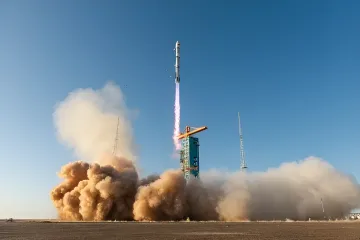
The Zhuque-3 rocket launched on August 19, 2026. During this flight, LandSpace successfully landed the first stage of an orbital rocket on land using deployable landing legs for the first time in the history of Chinese cosmonautics. After touchdown, the nine TQ-12A engines were removed and sent to the company's manufacturing facility in Huzhou, where they underwent maintenance and were prepared for re-testing. For LandSpace, this is the first instance where engineers have gone through the full cycle of restoration and repeated hot-fire testing of engines that have already flown in space and survived a landing.
What Was Tested on the Test Stand
The hot-fire test lasted about 185 seconds—comparable to the actual duration of the first stage's operation in flight. During the test, specialists varied the thrust level and fuel component ratio, simulating various phases of engine operation. According to LandSpace's statement, all nine units demonstrated parameters virtually identical to pre-flight metrics and met the requirements for reuse. This means the engines did not lose their service life or sustain hidden damage when operating in spaceflight conditions and during landing on legs.
The Economics of Reuse: The Path to 20,000 Yuan Per Kilogram
The reuse of the first stage is the main tool for reducing launch costs. According to LandSpace's own estimates, the first stage accounts for about 70% of the manufacturing cost of Zhuque-3, while fuel constitutes only 1–3% of launch expenses. The company aims in the future to reduce the cost of payload delivery to less than 20,000 yuan (approximately 3,000 US dollars) per kilogram. To achieve this figure, it is necessary not only to confirm engine reliability but also to significantly reduce the time and cost of stage maintenance after each landing.
Simplification of Procedures and Prospects for Zhuque-3
LandSpace notes that at the current stage, engineers have to determine which assemblies need to be disassembled and checked after each flight, and which can be left untouched. As statistics accumulate, the company intends to simplify inspection procedures, abandon excessive disassembly, and carry out some checks directly at the landing site, which should speed up the preparation of the rocket for the next launch. The Zhuque-3 itself is being developed to launch large satellite constellations: its height is 66 meters, its launch mass is about 570 tons, its body is made of stainless steel, and the first stage is designed for multiple uses.