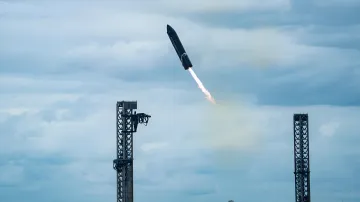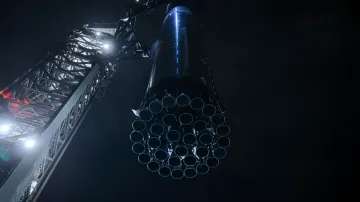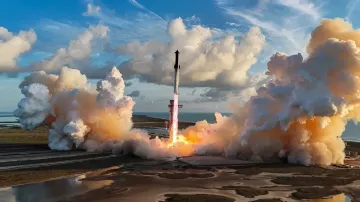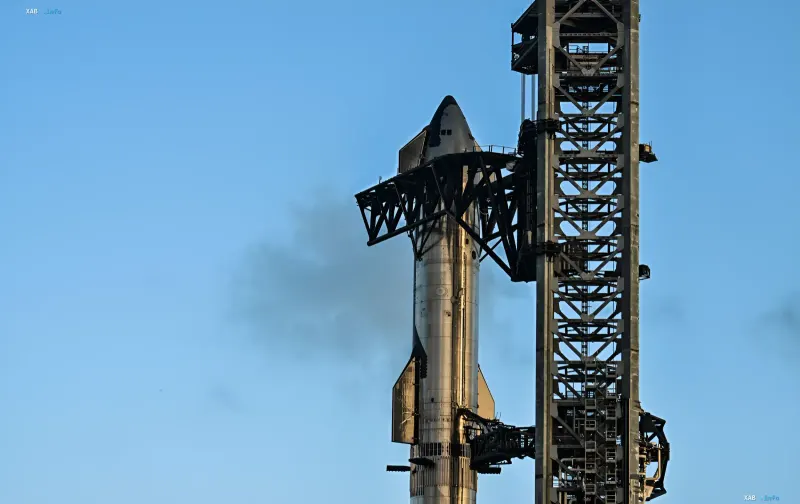
Elon Musk's SpaceX has achieved a breakthrough in creating a fully reusable space system: on November 14, the Starship spacecraft returned from Earth's orbit for the first time in history and was captured by the mechanical arms of the launch tower at the Starbase spaceport in Texas. The capture, dubbed 'Mechazilla' by company employees, marked the culmination of the 15th test flight, which launched on November 13. SpaceX broadcast host Dan Huot called the moment the 'missing link' and the 'holy grail of spaceflight.'
22.5 Hours, 14 Orbits, and 26 Starlink Satellites
The Starship upper stage spent about 22.5 hours in space and completed 14 orbits around the Earth, making it the longest mission in the program's history. At an altitude of approximately 260 km, the spacecraft deployed 26 Starlink V3 satellites, with communication established and the devices beginning to raise their orbits. On November 14, Starship fired its Raptor engine over the Pacific Ocean for deorbit, endured colossal heating upon atmospheric re-entry, and flipped into a vertical position over Starbase. In the final phase, the spacecraft engaged three engines, slowed its descent, and slowly settled into the mechanical 'hands' of the tower.
The 'Holy Grail' and the Failure of the Double Catch
Initially, the 15th mission was planned as the first attempt at a 'double catch'—returning both the Super Heavy booster and the upper stage to the pad. This plan failed: a few minutes after liftoff, the booster deviated from its course and broke apart over the Gulf of Mexico. According to a SpaceX representative, the Guidance, Navigation, and Control (GNC) system detected that the booster was not in the correct position for capture and automatically initiated an abort of its return. Elon Musk added that the booster experienced a 'slight fuel shortage.' Thus, successfully catching both parts of the rocket in a single mission was not achieved.
The Path to a Fully Reusable Rocket
Musk's goal is a rocket that flies to space and back as regularly as commercial airplanes, with minimal maintenance between flights. By comparison, only the first stage of Falcon 9 is reusable, while the second burns up in the ocean after every launch. The tower-catch technology has previously been used by SpaceX to retrieve the Super Heavy booster, but catching the actual spacecraft from orbit had not been accomplished. Meanwhile, Starship's thermal protection system made of black hexagonal tiles is not yet fully reusable, and SpaceX is developing new coating options.
What This Means for Ukraine
The Ukrainian military also depends on SpaceX systems: recently, restrictions on Starshield—the military version of Starlink—were recorded along the front line and in occupied territories, causing, according to the Ministry of Defense, military missions to be disrupted. Against this backdrop, Ukraine is taking steps toward its own satellite communications: on October 1, HIMERA, in partnership with Denmark's GomSpace, launched the OBRIA NANO test satellite into orbit, the first for a future independent Ukrainian network. At the same time, the country's space industry has lived without an approved state program for over seven years, and the question of whether Ukraine will be able to build its own launch vehicles again remains open.