SpaceX has published an official report dedicated to the 15th test flight of the reusable Starship rocket. The document, which is the first in a series of analytical materials by the company following this launch, contains technical details on exactly how the mission unfolded and what deviations from the standard scenario were recorded by engineers. According to SpaceX itself, the flight was of a «historic» nature, which underscores the significance of the 15th test run within the broader Starship development program.
Engine Malfunction and Premature Fuel Consumption
The key issues that SpaceX did not hide in the report were two incidents. First, one of the engines failed to start in normal mode. Second, the propellant was consumed earlier than scheduled. Both facts indicate that the mission did not go entirely according to plan, yet the company characterizes the flight as historic, which is likely due to the fact that Starship B42 still completed the main part of the test program and demonstrated the operability of key systems under real flight conditions.
What Is Known About the B42 Flight
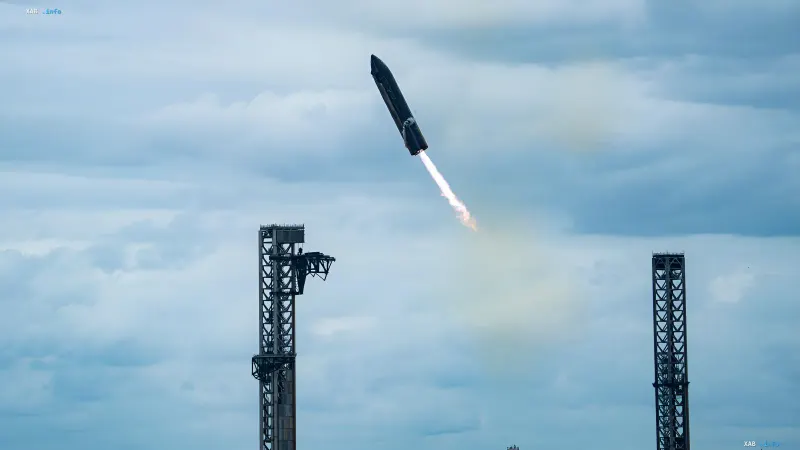
The photographs accompanying the publication capture Starship in an active flight phase: the vehicle is tilted relative to the vertical, a characteristic plume of flame erupts from the nozzle, and two tall steel support towers of the launch complex are visible in the background. The tilt angle and trajectory shape correspond to the maneuvers that Starship performs during the ascent or return phase. Specific numerical parameters — speed, altitude, engine run time — are not disclosed in the available part of the report.
Heat Shield and Future Reports
SpaceX explicitly points out that the published document is only the first in a series. The company promises to provide additional materials, including data on the condition of the heat shield tiles after atmospheric reentry. This block of information is traditionally considered one of the most critical for assessing Starship's reusability: the wear and tear of the thermal protection determines how many flight cycles the vehicle can withstand without major overhaul.
Context: The 15th Flight in the Starship Program
The fifteenth test launch continues SpaceX's multi-year program to refine the largest rocket in the history of astronautics. Each subsequent flight makes adjustments to the system's design and software, and the open publication of reports — including information about malfunctions — has become a steady practice of the company, allowing external observers and the scientific community to track the dynamics of Starship's development in real time.