SpaceX has officially announced massive investments in artificial intelligence infrastructure, with total funding for the construction of two supercomputing centers in Texas and Arizona exceeding 74 billion dollars. The announcement, made in November 2026, marks one of the largest private investment cycles in computing infrastructure in industry history. Both facilities will specialize in training advanced AI models and developing technologies for future space computing, directly linking ground infrastructure to the company's long-term space programs.
Texas: Expanding the Starbase Ecosystem
In the Rio Grande Valley, where the Starship program is already underway at Starbase, SpaceX plans to invest over 24 billion dollars in new supercomputing infrastructure. This decision builds on more than 15 billion dollars previously invested in constructing Starship itself and accompanying spaceport infrastructure. Thus, total investments in the Texas hub will exceed 39 billion dollars, transforming the region into one of the company's largest industrial clusters. During the construction phase, the project has already created over 3,000 jobs, and upon commissioning, a permanent staff of more than 500 specialists is expected. Energy autonomy deserves special attention: the facility will generate its own electricity and not use public grid capacity, reducing the load on regional power grids and ensuring stability for computing processes.
Arizona: A Campus Valued at Around 50 Billion Dollars
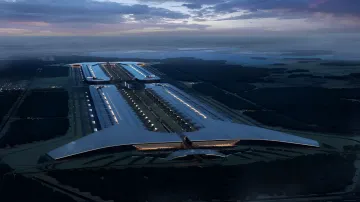
The second facility — a supercomputing campus in Arizona — is estimated at approximately 50 billion dollars and represents the larger financial portion of the overall program. Construction is already underway, and according to available data, about 5,500 jobs will be created during construction, with roughly 1,000 permanent positions after launch. The scale of the Arizona campus indicates that it will serve as the primary computational core for training the most resource-intensive artificial intelligence models, while the Texas center will be closely integrated with the operational tasks of Starship and Starbase.
Goals and Strategic Significance
Both centers will be used to train advanced artificial intelligence systems and develop technologies required for future space computing. This means SpaceX intends not only to apply AI to optimize its own processes — from rocket design to mission control — but also to create a computational base capable of handling orbital and interplanetary operations. Investments of this scale also signal that the company views AI infrastructure as a strategic asset comparable in importance to its space programs.
Context and Project Visualization
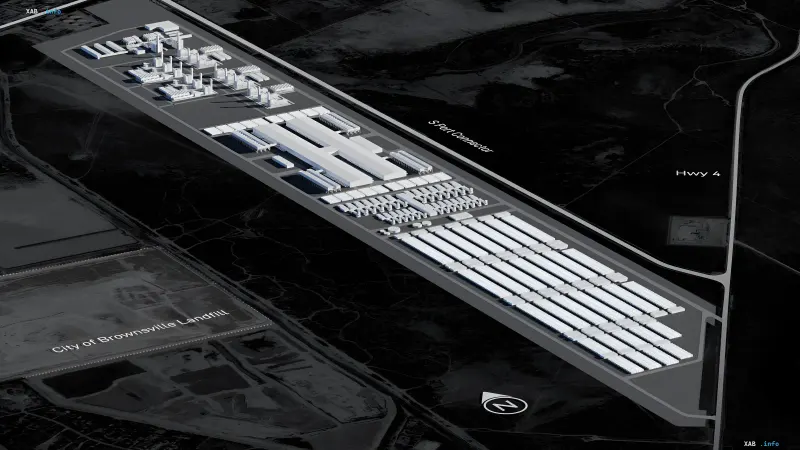
Publicly available 3D visualizations of the Texas facility demonstrate an elongated industrial complex oriented along the region's transport corridors: the renders show large computing blocks, power plants, and logistics zones adjacent to areas designated as "S Port Connector" and "Hwy 4," as well as the "City of Brownsville Landfill" territory. The layout confirms the scale: dozens of parallel computing module buildings occupy a significant area, matching the declared investment volume and the need for autonomous power supply. Together, the two projects form a distributed computing network designed by SpaceX to ensure the company's competitiveness in the race for technological leadership in AI and space computing for the coming decades.