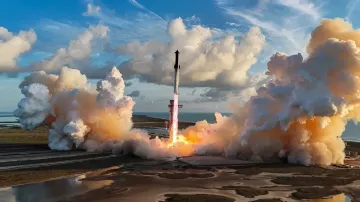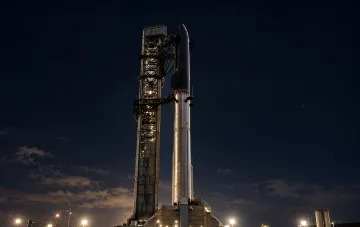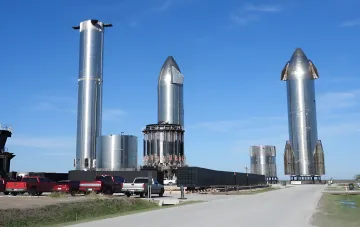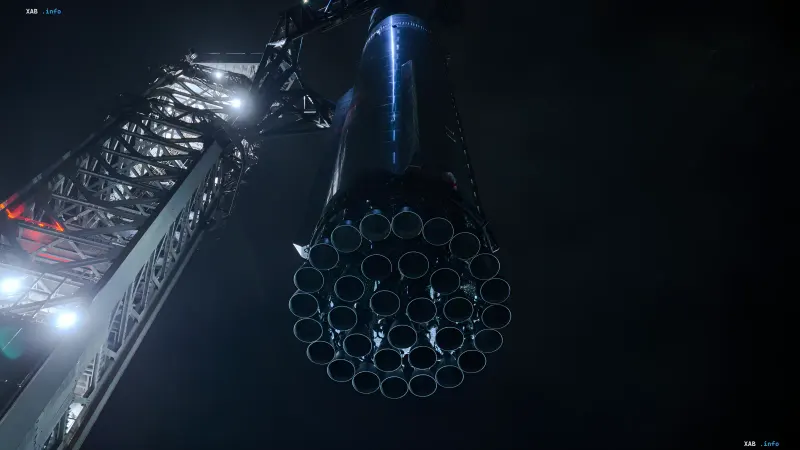
SpaceX has released a series of photographs capturing preparations for the 15th test flight of the reusable Starship rocket. The central focus of the images is the Super Heavy B22 booster, the first version of the third generation (V3), for which the company plans to implement a return-to-launch-site procedure involving capture by the Mechazilla tower's mechanical arms for the first time. The close-ups show all 33 Raptor 3 engines, grouped in their characteristic circular configuration on the base of the booster. This specific batch of engines will provide the thrust required to carry the orbital vehicle and its payload into space.
Ground rehearsal of capture: practicing the Mechazilla scenario
As part of pre-flight operations, SpaceX specialists raised the Super Heavy B22 booster to the planned capture height and conducted a series of ground tests for the maneuvers that must be executed upon the stage's return from flight. In particular, they verified the sequence of operations for the Mechazilla launch tower's arms—the very "mechanical hands" designed to catch the booster as it descends. While the company has successfully caught previous-generation boosters several times, this will be the first attempt for the Super Heavy V3. Successful completion of this procedure paves the way for a fully reusable third-stage cycle.
FAA License: the main hurdle before launch
With only three days left before the Flight 15 mission, the required Federal Aviation Administration (FAA) license has not yet been issued at the time of publication. Without regulatory approval, the launch cannot physically proceed. SpaceX has frequently faced licensing delays related to environmental and aviation requirements in the past, so the current situation is not exceptional, yet it puts additional pressure on the preparation schedule. The company typically publishes final confirmation of the launch date and window 24–48 hours before the event.
Mission Plan: 275 km orbit, 26 Starlink V3 satellites, and heat shield imaging
According to the approved mission plan, the Starship orbital vehicle is to reach an orbit at an altitude of approximately 275 kilometers and remain there for over 22 hours, completing roughly 14 orbits around the Earth. During the flight, the spacecraft will deploy 26 Starlink V3 satellites. According to SpaceX, each of these will provide approximately 1 Tbps of additional throughput to the satellite network, with the entire batch combined delivering about 26 Tbps. Three satellites in this group are additionally equipped with cameras designed to image the Starship heat shield as it re-enters the atmosphere. The data obtained will be critical for validating the design solutions for thermal protection, which remains a key element in ensuring the ship's reusability.
Historical Significance: for the first time, both stages to return to the site
The upcoming flight could be one of the most important milestones in the development of the Starship system. For the first time, SpaceX intends to return both stages of the orbital rocket to the launch site—both the Super Heavy booster and the Starship vehicle. If the scenario is fully realized, it will be a turning point in the history of astronautics: no other company in the world has previously demonstrated the simultaneous recovery of both stages of a heavy orbital rocket. The launch is scheduled for November 14 (Moscow time) in a window from 01:45 to 03:00. Successful execution of all Flight 15 mission objectives will significantly bring SpaceX closer to its stated goal of creating a fully reusable system for transporting cargo and, eventually, people to orbit and beyond.