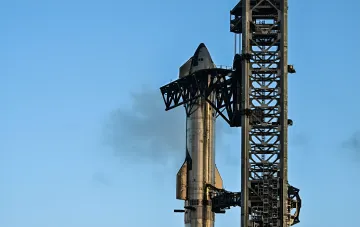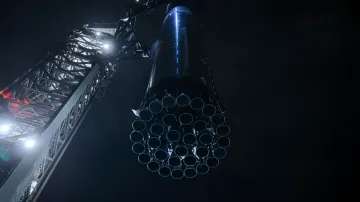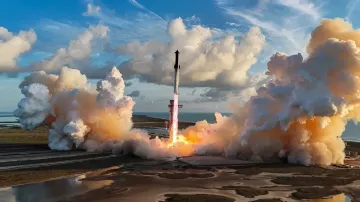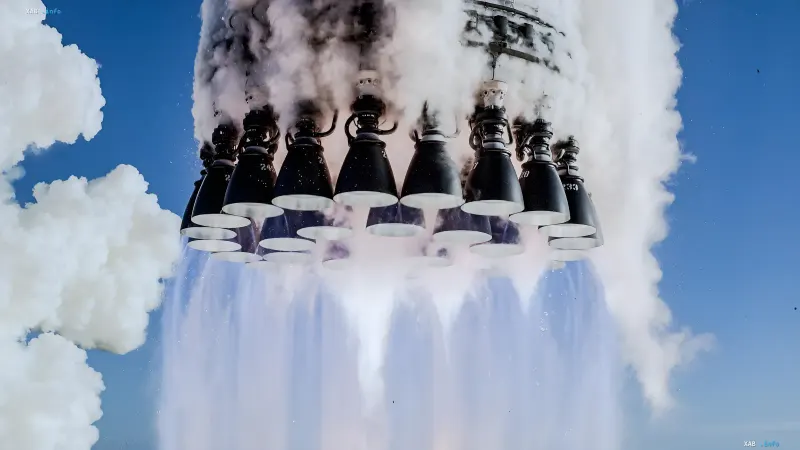
SpaceX has published a series of photographs showing the production team posing next to the Starship 42 spacecraft ahead of its 15th test flight. The images released by the company capture the launch preparation phase and demonstrate the scale of work on the world's largest rocket. At the same time, the company unveiled footage of the propulsion system in action, displaying powerful streams of flame and dense clouds of smoke rising from the Raptor engines.
Propulsion System in Action
The published photographs capture the ignition of the Raptor engines, which use methane and liquid oxygen as propellant. The footage shows characteristic conical nozzles spewing fiery streams, while a cloud of steam and smoke forms around the launch complex. These images illustrate the operation of the propulsion system, which provides the thrust required to launch the spacecraft into orbit and, equally importantly, for its controlled return to Earth.
Orbital Mission and Starlink V3 Satellites
The launch took place on November 13 from the Starbase facility in Texas. During the flight, the spacecraft was successfully inserted into orbit, where it deployed 26 Starlink V3 satellites. After completing its primary mission, the vehicle spent approximately 22.5 hours in space and completed 14 orbits around the Earth, making this test the longest Starship flight to date.
Historic Mechazilla Tower Catch
On November 14, Ship 42 returned to the launch site and was caught by the mechanical arms of the Mechazilla tower for the first time in history. This maneuver marked a critical milestone toward full reusability for the Starship system: for the first time, the upper stage did not splash down in the ocean, but was intercepted and secured by the tower after returning from orbit.
Super Heavy Booster Return Failure
The return of both stages was not entirely successful. The Super Heavy Booster 22 failed to execute its return maneuver due to premature engine shutdown amid insufficient propellant mass. The flight control system aborted the catch and directed the booster to splash down in the Gulf of Mexico, confirming that despite the breakthrough with the upper stage, the challenge of fully recovering both parts of the rocket remains unsolved.
Significance of the Test
Overall, the 15th flight confirmed the core capability for which the Starship program is being built—returning the spacecraft from orbit followed by tower capture. The combination of results—the orbital deployment of 26 Starlink V3 satellites, record flight duration, and the historic first-ever ship intercept by Mechazilla's arms—cements SpaceX's progress toward full reusability, while the Super Heavy booster anomaly remains a key objective to be resolved in upcoming tests.