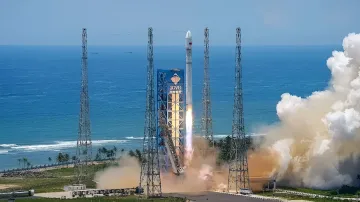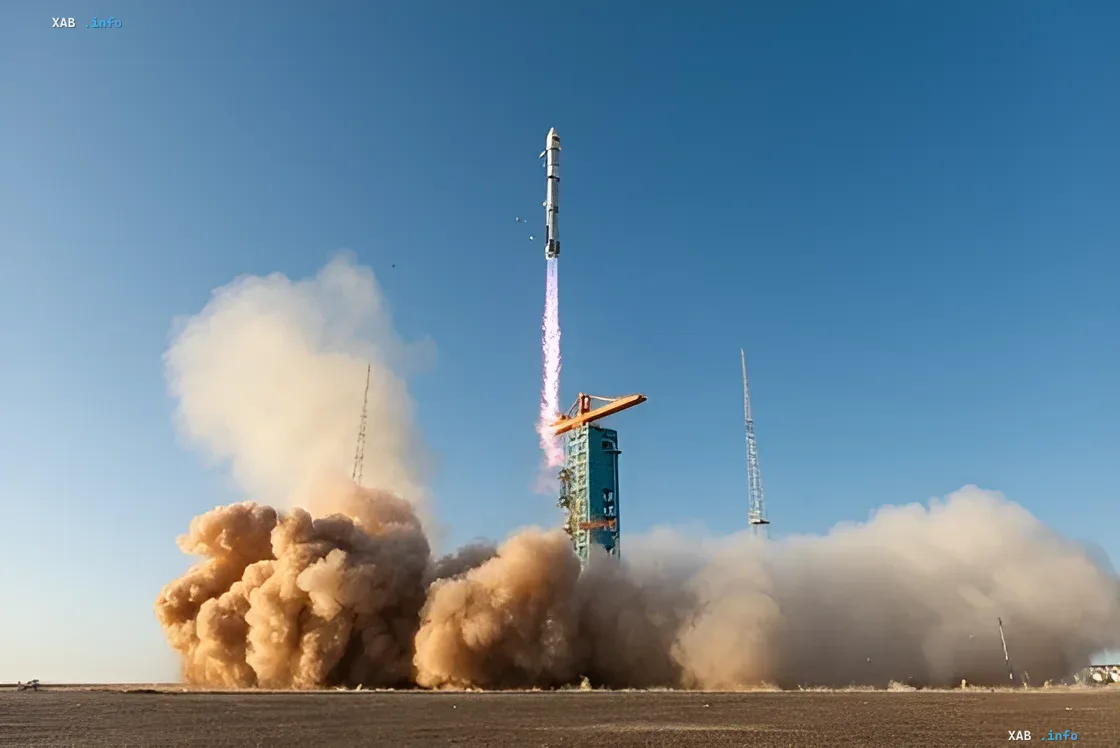
According to the Xinhua news agency, on August 19, 2026, the reusable rocket Zhuque-3 was successfully launched, and its first stage landed on solid ground. The key feature of this launch was the use of a deployable landing gear system to return the stage to Earth — according to the agency, this is the first time in the history of Chinese spaceflight that such technology has been used. Footage from the launch site captured a characteristic column of flame and a vast cloud of dust rising over the desert pad, which is typical of ground-based landing maneuvers.
A historic shift from sea to land
The achievement is a logical continuation of China's series of stage-recovery experiments. Just over a month earlier, on July 10, the first stage of the Long March-10B rocket was returned to a sea platform and lifted using a net system — at that time, China carried out such a sea "catch" of a stage for the first time in history. The transition from a sea platform to a ground landing on landing gear means that the country is mastering a more complex, technology-intensive scenario, close to the approaches used in the commercial sector.
Timeline and technological logic
Reusable rocket technology is regarded by the industry as a key factor in significantly reducing the cost of space exploration: reusing stages allows the cost of each launch to be cut. For context, Elon Musk's SpaceX and Jeff Bezos's Blue Origin have been operating launch vehicles with reusable stages since 2015, meaning China is more than a decade behind in the industrial application of this technology, but in 2026 it is demonstrating an accelerated catch-up trajectory.
Contradictory data
The news flow around Chinese reusable launch vehicles features diverging accounts. On the one hand, Xinhua and a number of regional outlets report a successful ground return of the Zhuque-3 stage and a successful sea landing of the Long March-10B/10A. On the other hand, certain sources (in particular, 3dnews.ru) report the failure of a second attempt with the Chang Zheng-12A rocket, whose reusable first stage, according to them, crashed, while focus.ua describes the fall to Earth of the first state reusable rocket after launch. Thus, successes and failures relate to different vehicles and different launches, and they should not be mixed: the confirmed fact remains the ground landing of Zhuque-3, while the fate of a number of other experimental stages is disputed or described as unsuccessful.
Strategic implications for the global market
The new achievement brings China closer to the goal of industrializing reusable rocket technology against the backdrop of growing competition on launch cost and capability in the global space market. The ability to land a stage on solid ground with landing gear opens the way to more frequent reuse and, as a result, to price pressure on commercial customers. For the global market, this means that in the coming years competition in the launch segment may cease to be a duopoly and turn into a multipolar race, with China as a full-fledged participant.