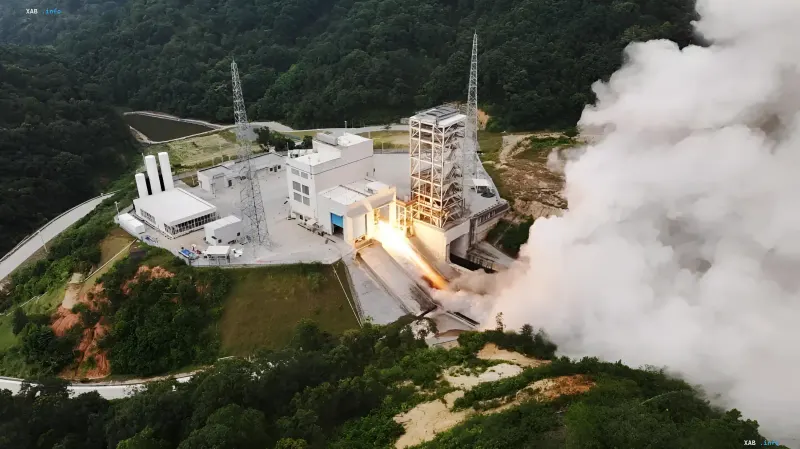
China's CAS Aerospace has announced the successful completion of key bench tests for two independently developed liquid rocket engines, Liqing-1 and Liqing-2. Both units operate on a liquid oxygen and kerosene propellant combination and are designed for advanced launch vehicles, including those intended for reuse. The performance figures claimed by the developers indicate that China continues to expand its own propulsion base for a new wave of launch systems. The image shows bench testing of the engine at a mountain test facility, accompanied by a powerful release of steam and combustion products.
Two Engines Under a Single Strategy
Both engines were created as part of a unified propulsion preparation program for advanced carriers. Liqing-1 and Liqing-2 differ in thrust class, but share a common propellant type and a common goal: to provide the foundation for reusable rockets with high launch frequency. Successful completion of key tests marks the transition from the development stage to serial production preparation, although the exact schedules for the first flights of the carriers utilizing these engines have not yet been disclosed.
Liqing-1: 30 Tons of Thrust for Lihong-2
The more compact Liqing-1 develops approximately 30 tons of thrust. During a series of tests, the engine performed four firings with thrust variations ranging from 40% to 100% of the nominal rating. The total operating time during the tests exceeded 700 seconds, with the longest continuous firing lasting 300 seconds. The aggregate's total running time in reliability checks has already surpassed 2,000 seconds. According to the developers' plans, Liqing-1 will become the main propulsion system for the Lihong-2 reusable rocket.
Liqing-2: 110 Tons for Frequent Launches
The thrust flagship, Liqing-2, delivers about 110 tons. It has undergone several long-duration bench tests, each lasting over 1,000 seconds. The engine's total running time during reliability checks exceeded 5,000 seconds. Developers expect to utilize Liqing-2 in the Lijian-2 rocket, which is focused on high-frequency reusable launches and relatively low launch costs.
Testing Regimes: From Subcooled Oxygen to Thrust Variation
During the checks, specialists evaluated engine performance across a wide range of parameters: at high and low thrust, under varying propellant component ratios, at different pump inlet pressures, and using subcooled liquid oxygen. This set of regimes confirms the units' resistance to deviations from nominal conditions and their readiness for serial operation.
The Path to Serial Production
CAS Aerospace refers to the completion of key tests as the next stage in preparing the engines for serial production. The company did not disclose the timelines for the first flights of the Lihong-2 and Lijian-2 rockets, but the accumulated running time — over 2,000 seconds for Liqing-1 and over 5,000 seconds for Liqing-2 — indicates that the units have passed the bulk of resource verifications. For the Chinese space industry, this is a step toward building its own fleet of reusable carriers capable of competing in launch frequency and cost.