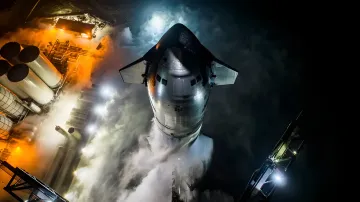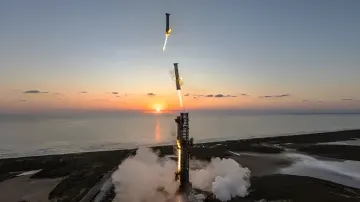
SpaceX is preparing a fundamentally new phase in the history of crewed and uncrewed astronautics: the company plans for the first time in history to catch both stages of its super-heavy Starship rocket in mid-air — the Super Heavy booster and the Starship spacecraft itself. Elon Musk announced this during the company's third-quarter 2026 financial results earnings report, adding that the attempt could take place as early as next month, November. The SpaceX founder called the upcoming test a "reusable milestone for human civilization," emphasizing that successful execution will fundamentally alter the economics of spaceflight and pave the way to regular, minimal-cost missions to orbit.
Mechanical "Chops" of the Mechazilla Tower
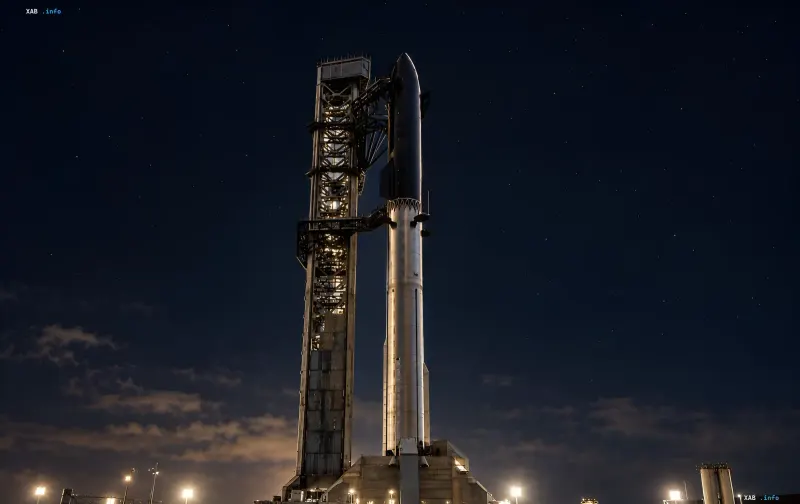
A key element of the upcoming operation will be the Mechazilla launch tower, equipped with special mechanical arms known as "chopsticks." According to SpaceX engineers, these arms are designed to catch the 120-meter Starship stack during its vertical descent after stage separation. The tower's structure is designed to hold both stages simultaneously, preventing the rocket blocks from falling into the ocean and ensuring their reusability. Musk acknowledged that success in the early flights is not guaranteed, but stressed that the probability of a successful landing is "fairly high." In the event of a failure, he noted that the company already has a schedule of regular launches through the end of 2026, and the pace of the program will accelerate in the future.
Two-Stage Architecture and Raptor Engines
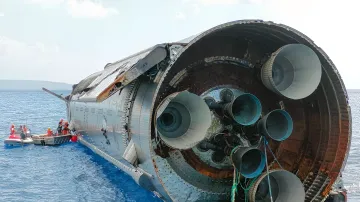
The Starship system is a two-stage vehicle consisting of the lower stage — the Super Heavy booster — and the upper stage, the Starship spacecraft itself. Both stages run on liquid methane and liquid oxygen, with thrust provided by Raptor engines developed in-house by SpaceX. This combination enables the delivery of massive payloads to orbit at significantly lower costs compared to previous-generation expendable rockets. Transitioning to a fully reusable scheme where both stages return to the launch site is the program's primary goal, which the company is approaching after a series of test flights.
Results of the Previous Test Flight
Just prior to announcing the new mission, in September 2026, SpaceX conducted another Starship test flight, during which the rocket achieved several important technical objectives. However, the flight was accompanied by serious difficulties: one of the Raptor engines shut down prematurely during the ascent phase, forcing engineers to cut the mission duration from the planned 10 hours to three, limiting it to two orbits around Earth. Upon mission completion, the Super Heavy booster made a soft splashdown in the Gulf of Mexico, while the Starship spacecraft crashed into the Pacific Ocean north of Hawaii after deorbiting. Neither part was recovered, but the upcoming mission using the Mechazilla tower is expected to change this practice.
Context and Strategic Goals of the Program
The announcement of the mid-air catch attempt comes against the backdrop of SpaceX's massive infrastructure expansion. The company continues construction of the Starship megabase at Cape Canaveral, with investments estimated to reach hundreds of billions of dollars. Successfully completing the task of returning both stages will not just be a technical achievement, but an economic turning point: the cost of a kilogram of payload to orbit could drop by orders of magnitude, unlocking massive satellite constellation deployments, lunar and Martian missions, and eventually commercial space tourism. For the industry as a whole, this represents a transition from the era of expendable rockets to the era of reusable spacecraft, comparable to the shift from steamships to airline routes in ground transport.