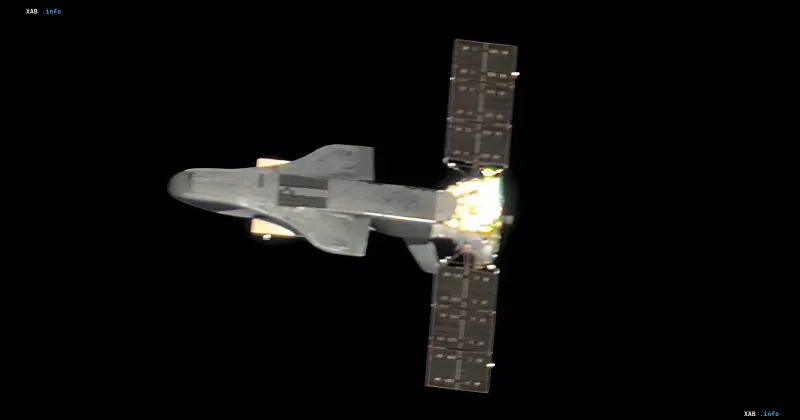
US intelligence agencies have published the first public image of a Chinese spacecraft that closely resembles the American X-37B unmanned orbital vehicle in appearance and functional purpose. The image was released as part of a space threat report prepared by the Defense Intelligence Agency of the US Department of Defense, and additional structural details were confirmed by Maxar satellite monitoring data. According to American analysts, the spacecraft is capable of operating at the boundary of the atmosphere and space, entering orbit, and returning to Earth, making it one of the few objects of this class in the world.
What the Images Show
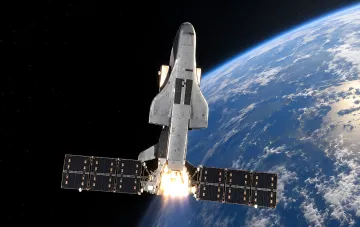
According to the published materials, the Chinese spacecraft has an airplane-like shape with wings and a streamlined fuselage, typical of reusable orbital vehicles. Intelligence indicates that such platforms primarily serve as a means of access to space, a testbed for new technologies, and a potential tool to support military operations. In open sources, the vehicle is associated with the name 'Shenlong', and the Long March 2F rocket is listed as the launch vehicle.
Mission Chronology
According to the US intelligence report, China has already conducted at least four missions of this type of spacecraft. The first launched on September 4, 2020, the second on August 4, 2022, the third on December 14, 2023, and the fourth on February 7, 2026. It is noted that during the second and third missions, the spacecraft spent 276 and 266 days in orbit respectively, indicating prolonged stay in space and likely conducting experiments under orbital operational conditions.
Comparison with the American X-37B
For comparison, the report cites the characteristics of the American X-37B, developed by Boeing at NASA's initiative and later transferred to the military; its first space flight took place in 2010. The fuselage length of the X-37B is 8.28 m, wingspan 4.6 m, maximum takeoff weight about 4,990 kg, payload up to 900 kg, and claimed maximum speed is around 28,200 km/h. Judging by the published images, the Chinese spacecraft mirrors this architectural logic, although intelligence has not disclosed the exact parameters of its weight and payload.
Strategic Context
The US report emphasizes that the transition from expendable launchers to reusable systems significantly reduces the cost of access to space through recovery, repair, and reuse of spacecraft. The document explicitly states that the US currently remains the only country with an active reusable launch vehicle program, while China aims to become the second nation in this regard. According to intelligence assessments, Chinese space companies are pursuing military, civil, and commercial goals simultaneously, making the 'Shenlong' program a key element of Beijing's long-term space strategy.