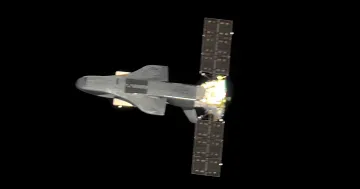
US Department of Defense intelligence has released a declassified image capturing a secret Chinese spaceplane whose design almost completely mirrors the American X-37B orbital vehicle. This was reported by RBC-Ukraine, citing a report by the US Defense Intelligence Agency (DIA). The publication of the image has become one of the few public confirmations that the PRC possesses its own reusable orbital spacecraft capable of carrying out tasks unavailable to classical satellites.
The Image That Changed Everything
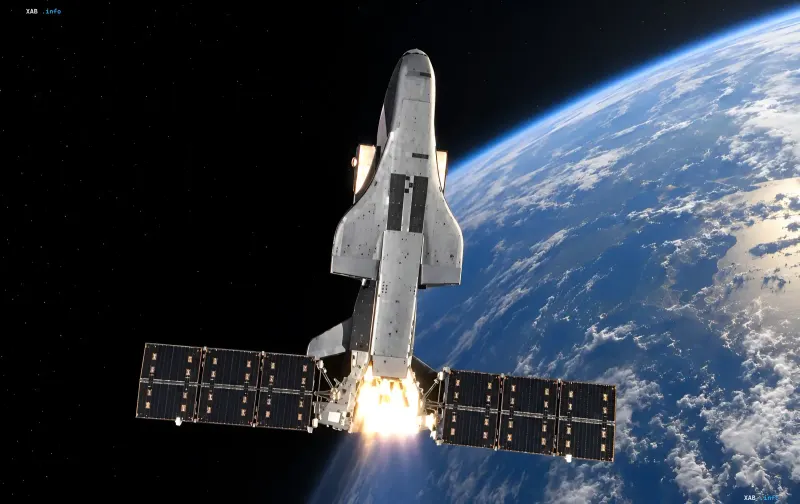
According to the DIA report, the Chinese vehicle features a delta wing, a payload bay, a dark thermal protection shield, and a service aft module equipped with solar panels. It is this combination of features — fuselage shape, wing placement, and thermal protection characteristics — that allowed analysts to conclude that the design was largely borrowed from the X-37B. The report emphasizes that the high maneuverability of such orbital ships makes them more effective than traditional satellites, as they are capable of changing orbits, performing inspections, and returning to Earth for reuse.
'Shenlong' or CSSHQ: What the Vehicle Is Called
The official name of the vehicle in China remains classified, which is why two parallel designations have emerged around it. Western media most often call it 'Shenlong' (which translates to 'dragon'). At the same time, PRC state media use the abbreviation CSSHQ, which stands for 'multi-use experimental spacecraft'. The divergence in terminology reflects varying degrees of openness: the Western side operates with an established informal name, while the Chinese side assigns its own more 'neutral' experimental designation to the vehicle.
Maneuvers and 'Inspector': What Was Tracked This Year
Special attention in the DIA report is paid to the vehicle's behavior during recent maneuvers. According to US intelligence, the Chinese spaceplane repeatedly released and recaptured a small inspector satellite. Such activity was recorded in June, July, August, and September. This pattern — deploying a small craft, approaching a target object, and subsequently returning — is viewed as a demonstration of orbital inspection capabilities and the potential for servicing or intercepting objects in orbit, which takes the vehicle beyond a purely demonstrative mission.
Context: Other Threatening Technologies
In addition to spaceplanes, the Pentagon pointed out a number of other technologies in the same context that, according to US intelligence assessments, pose a threat. Specifically, the report notes that Russia is developing the 'Nivelir' system to destroy satellites with kinetic projectiles. Separately, it was recorded that small craft recently made a critical approach to the commercial ICEYE radar satellite, which reportedly provides intelligence data to Ukraine. The combination of these factors — orbital spaceplanes, kinetic anti-satellite weapons, and proximity approaches by small craft — forms a picture in the Pentagon's assessment of growing pressure on space infrastructure.
Why This Matters
The publication of the image and maneuver details is significant primarily because it moves the discussion about the Chinese orbital spacecraft from the realm of speculation into the realm of documented observations. For the US and its allies, this means the need to reassess risk estimates for commercial and intelligence satellite constellations, and for China, it represents the West's de facto acknowledgment that it possesses a reusable orbital vehicle. Future dynamics will depend on whether new public confirmations of maneuvers emerge and whether China will disclose the official name and purpose of the vehicle.