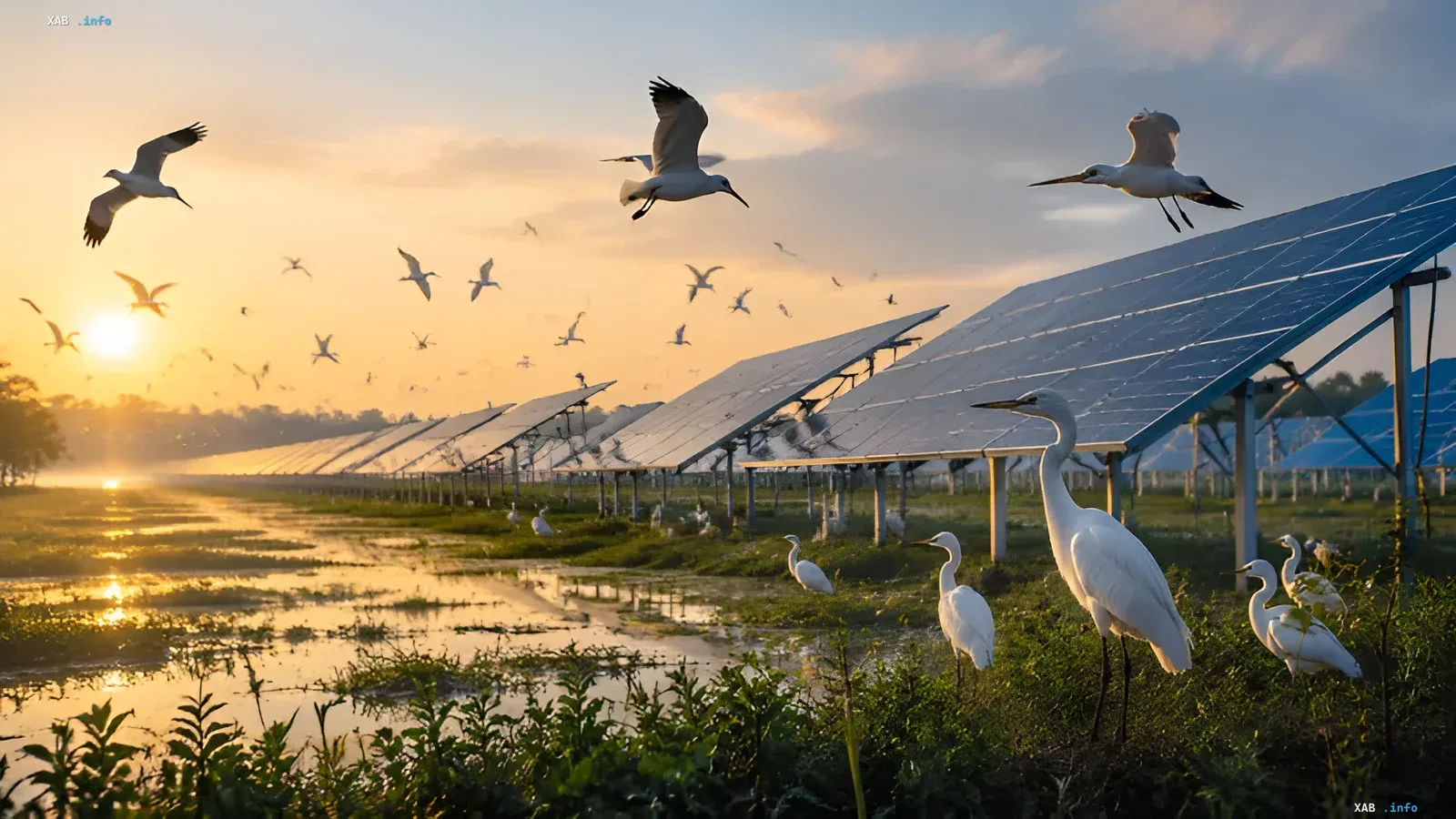
An international team of researchers from China, Vietnam, and the United States published a study in the journal Science identifying a statistically significant negative relationship between state support for solar energy in China and bird diversity. The scientists analyzed more than 2,300 administrative districts of the country over the period from 2014 to 2023 and concluded that the more resources and land were directed toward the development of photovoltaics, the fewer bird species inhabited those districts. According to the authors' estimate, a one-standard-deviation increase in the "stringency" of solar energy support policy was accompanied by a decline in the bird diversity index of approximately 2.1%.
Methodology: not just panel area, but policy "stringency"
The key feature of the study is that the independent variable was not simply an installed-capacity metric, but a special index of the "stringency" of state policy supporting photovoltaics. This approach made it possible to assess precisely the impact of the mechanisms that stimulate the construction of solar facilities, rather than only the already-built infrastructure. As an indicator of the state of bird communities, the Shannon diversity index was used, which accounts for both the number of species and the evenness of their abundance distribution. The source of bird data was observations from the national China Birdwatching Record Centre, cross-referenced with maps of "solar policy" and land use.
Impact mechanism: habitat fragmentation
The main cause of the decline in biodiversity, according to the authors, is the alteration of habitat structure. Large solar farms require land conversion, leading to the loss of foraging grounds, the destruction of nesting sites, and the fragmentation of remaining natural areas. The most pronounced effect was identified in economically developed regions and areas with initially complex ecosystems, where the replacement of natural landscapes with solar infrastructure has the greatest impact. At the same time, in arid desert regions with low initial biological activity, no statistically significant harm to birds was detected.
Contradictory data
In the study itself, the authors emphasize that solar energy is not unambiguously harmful to nature: panels can create shaded zones, promote plant growth, and form new refuges for a range of insects, birds, and animals. On the one hand, a clear negative effect was recorded across the entire sample; on the other, its magnitude depends strongly on the location of the facilities, and in some territories (desert, biologically "poor") no significant damage was recorded. Thus, this is not a matter of universal harm, but of spatially heterogeneous impact, where the correlation between support policy and reduced diversity is statistically confirmed, but the causal link is mediated precisely by changes in land use.
Scientists' recommendations: biodiversity-aware planning
The researchers call for the biological value of territories to be taken into account when planning new solar power plants, especially in areas along bird migration routes, and for the energy transition to be accompanied by stricter conservation mechanisms. "Our results highlight a critical ecological dilemma: without careful spatial planning, policy-driven solar expansion may inadvertently threaten local biodiversity," the article states. "We argue that the future development of photovoltaic energy must be accompanied by strict measures to conserve biodiversity, especially in economically developed regions with high habitat complexity." The context of the study is important: China has maintained its world leadership in expanding solar generation in recent years, making the question of the ecological cost of such expansion particularly relevant.