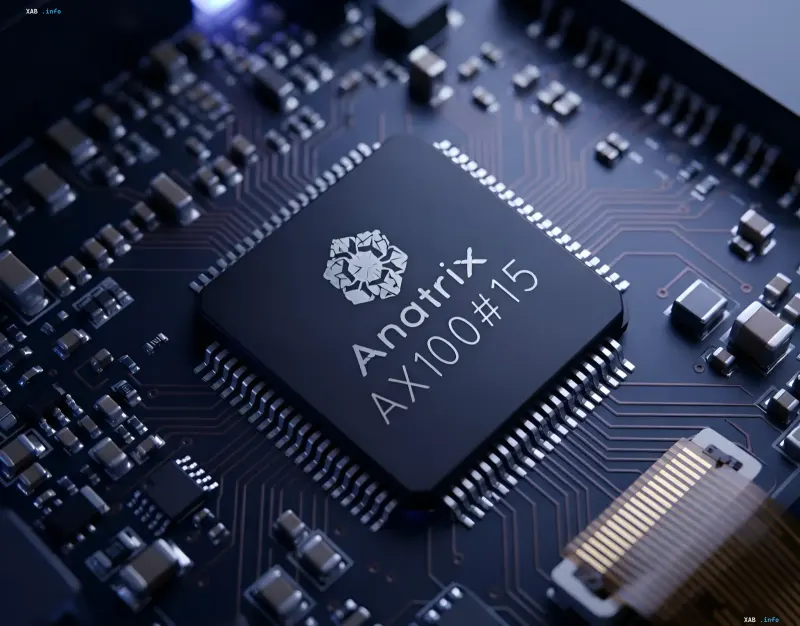
Chinese developers have unveiled a prototype of the AX100 chip, which they call the world's first fully integrated analog processor. The device is capable of solving matrix equations in a single step: according to test results, a single operation takes less than 100 nanoseconds, while power consumption is around 80 milliwatts. The chip casing features the Anatrix marking and the AX100 index, corresponding to the device's positioning as a specialized analog accelerator.
How Analog Computation Works
Matrix equations form the basis of many modern computational tasks—from training large language models to robot control and signal processing in communication networks. Digital processors solve them through a large number of sequential multiplication and addition operations: for a 512×512 matrix, this amounts to about 500 million such operations, taking from tens to hundreds of microseconds. The analog approach works differently: it uses the physical properties of electrical circuits to solve the problem in parallel. The matrix is directly converted into a circuit that independently reaches an equilibrium state, after which the processor reads out the finished result without lengthy iterations—this simultaneously reduces delays and power consumption.
Accuracy: The Barrier Finally Broken
For a long time, accuracy remained the main obstacle to analog computing. In October 2025, researchers from the Artificial Intelligence Institute of Peking University published a paper in which they managed to improve accuracy from around one-hundredth to one-ten-millionth. According to the source, it was this breakthrough that allowed the development to move from the laboratory to the production stage and present a test-ready sample.
Manufacturing Without Advanced Process Nodes
Of particular significance is that the AX100 does not require advanced technological processes: the chip can be manufactured using already mastered production technologies. This lowers the entry barrier and makes scaling more affordable compared to solutions tied to the finest nodes, potentially reducing the cost of mass production.
What This Means in Practice
If the claimed characteristics are confirmed by independent testing, analog accelerators of this type could become a niche yet energy-efficient alternative to digital GPUs and specialized accelerators in tasks where latency and specific energy consumption are critical. For now, however, this is a prototype, and the market has yet to evaluate the chip's actual performance outside of controlled laboratory conditions.