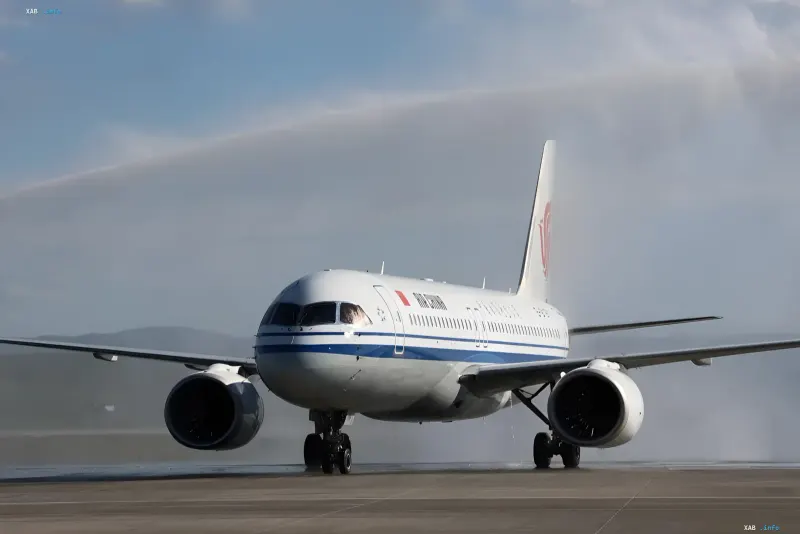
In August 2026, the Chinese aviation industry faced a paradoxical situation: the national passenger aircraft COMAC C919 became the object of heightened interest from the country's largest carriers, yet the manufacturer proved unable to meet this growing demand. While airlines are actively planning fleet upgrades, shifting from Western giants to domestic developments, COMAC is forced to admit falling behind its own delivery schedules.
Demand Exceeds Capacity: Airlines Await the C919
Interest in the C919 has ceased to be merely a declaration of loyalty and has turned into a genuine business interest. A representative of Shenzhen Airlines, China's fifth-largest carrier, confirmed the company's intention to begin operating the C919 in the near future. This is particularly notable given that the airline's fleet has historically been formed primarily with Airbus aircraft. Loong Air, a fast-growing carrier, has taken a similar stance, viewing the Chinese airliner as a key element of its strategy to diversify its fleet and reduce operational risks.
Production Gap: From 75 to 15 Aircraft
However, customer ambitions have clashed with production reality. At the beginning of 2025, COMAC announced plans to deliver 75 C919 aircraft to customers. Later, realizing the scale of the problems, the company adjusted its forecast, lowering the target to 25–28 aircraft. By the end of the year, the actual figure was only 15 delivered airframes. Such a gap between plan and fact (five times less than the initial forecast) shocked the industry and revealed systemic issues in the supply chains for critical components.
Engine Dependency and the "American Factor"
The main "bottleneck" for C919 production remains the dependence on Western technology. Although a significant portion of the aircraft's structure—including the fuselage, wings, and tail elements—is manufactured in China, the airliner critically depends on foreign systems, particularly engines and avionics. The main supplier of powerplants is the CFM International consortium, which produces the LEAP-1C engines. In 2025, deliveries of these engines to China were temporarily suspended amid tightening US export restrictions, which paralyzed COMAC's assembly lines.
Import Substitution Strategy: The CJ-1000A Project
Recognizing the risks of dependence on Western partners, China has accelerated the development of its own analogues. The Aero Engine Corporation of China (AECC) is actively working on the CJ-1000A engine, which is expected to eventually fully replace the American-French LEAP-1C. However, the transition to domestic engines is a lengthy process requiring not only the completion of development but also the passage of complex certification procedures, which may be prolonged given the current geopolitical tensions.