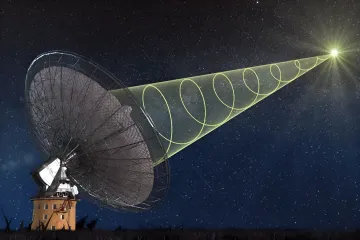
Chinese astronomers have concluded a massive phase of analyzing data collected by the world's largest 500-meter aperture spherical radio telescope, FAST. The researchers focused on 33 star systems with exoplanets, scanning them for narrowband radio signals of technognature origin. Such signals are considered prime markers of potential extraterrestrial technological civilizations in space.
Essence of the discovery: searching for anomalies in K2-155
During deep space scans, researchers flagged an object originating from the direction of the K2-155 star system, located 238 light-years away from Earth. Previously, an exoplanet within the potentially habitable zone was discovered there. The radio signal detected at 1140.604 MHz exhibited several classical characteristics of an artificial source: it was narrowband, and its frequency shifted due to the Doppler effect, indicating relative motion between the source and Earth.
Contradictory data
Despite initially matching several artificial criteria and successfully passing the multibeam coincidence test (the signal appeared in only one of FAST's 19 receiver beams, ruling out local Earth interference), subsequent in-depth analysis revealed contradictory findings. Scientists identified polarization anomalies observed in only a single channel while absent in adjacent ones, casting doubt on the extraterrestrial origin hypothesis.
Expert assessments and future outlook
The signal has been officially designated NBS 260108. Currently, the scientific community lacks sufficient grounds to claim humanity has encountered an actual alien message. Nevertheless, experts note that analyzing this event has significantly improved algorithms for filtering space and terrestrial radio interference for future SETI observations.