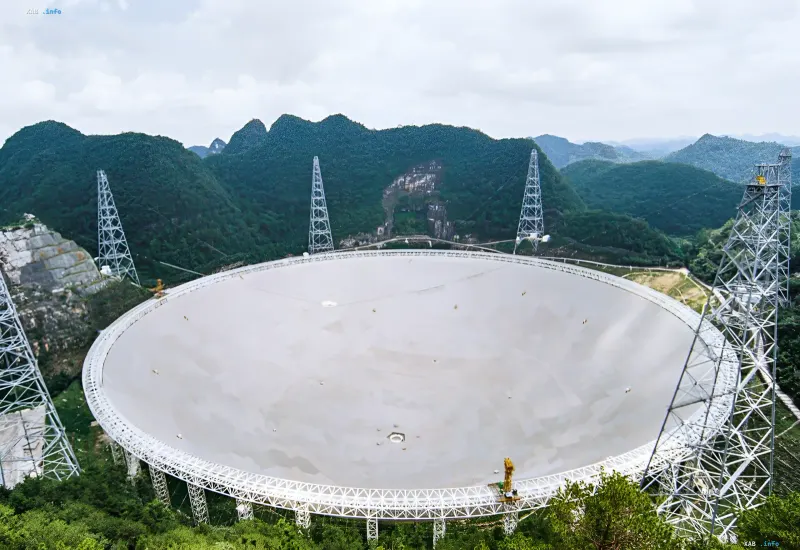
September 2026 marks exactly 10 years since the completion of construction for the legendary FAST (Five-hundred-meter Aperture Spherical Telescope), located in the picturesque mountainous region of Guizhou Province in southwest China. This grandiose scientific instrument, deservingly bearing the poetic moniker "China's Sky Eye," retains its status as the world's largest single-aperture radio telescope. Over years of productive operation, the observatory has made a colossal contribution to global astrophysics, discovering more than 1,300 new pulsars and significantly expanding the boundaries of our understanding of the universe.
Engineering Innovations and Managing Thermal Deformations
In a recent exclusive interview, Jiang Peng, Deputy Director of the National Astronomical Observatories under the Chinese Academy of Sciences and Director of the FAST Operation and Development Center, shared unique technical details regarding the creation of this extraordinary facility. One of the primary engineering challenges in designing the giant ring support frame, resting on 50 massive columns, was the need to compensate for thermal fluctuations. Metal inevitably expands under the scorching sun and contracts during cold periods, which is typically handled by installing expansion joints or welds.However, for FAST, preserving the absolute monolithic integrity of the ring was critical for maintaining the rigidity of the entire structure. Engineers found an elegant and efficient solution: the top of each of the 50 supports was equipped with special sliding mechanisms. These elements allow the entire ring structure to slide and shift freely during thermal expansion and contraction, completely eliminating the risk of dangerous internal stresses and framework deformations.
Unique Perforated Geometry and Environmental Sustainability
An equally impressive engineering solution is the telescope's giant reflecting surface, visually resembling a colossal bowl. Due to the colossal surface area, designers faced an acute problem of rainwater accumulation and excessive wind loading. The issue was brilliantly resolved by using perforated panels with a light transmittance of up to 50%. Thanks to this fine-mesh structure, atmospheric precipitation passes smoothly through the telescope fabric downwards, drastically reducing the windage of the structure during storms.Moreover, the perforation performs an important ecological function: natural sunlight penetrates unhindered through the holes in the reflecting panel to the ground. Thanks to this unique technical approach, the natural vegetation cover on the mountain slope hidden directly beneath the multi-thousand-ton structure of the telescope continues to thrive and stay green, minimizing the observatory's anthropogenic impact on the fragile mountain ecosystem of the region.
Contradictory Data
Open sources and official reports occasionally spark discussions regarding the exact dates and chronology of the telescope's official commissioning. While official statements and recent publications tie the current celebrations to the 10th anniversary of the completion of construction work and assembly in September 2016, some scientific databases and encyclopedic references count full-scale scientific operations from the official launch and first calibration in January 2020. Nevertheless, the expert community agrees that the decade since the end of large-scale construction marks a milestone of project maturity.