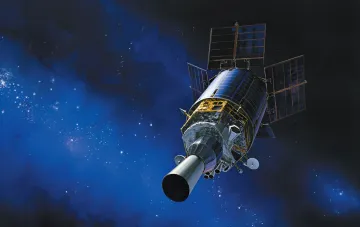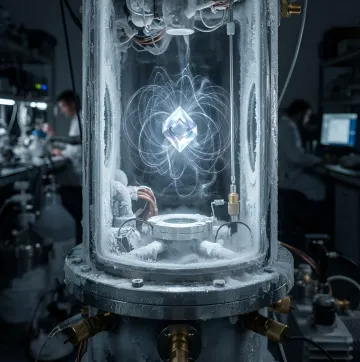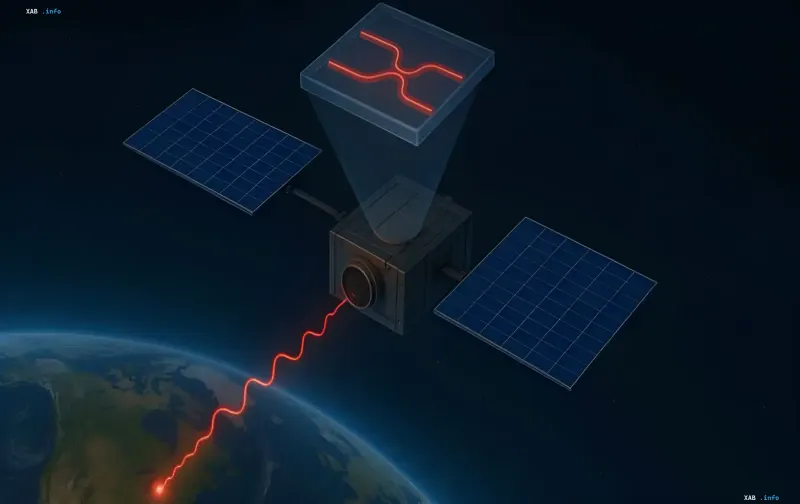
Physicists from the University of Vienna have successfully performed quantum operations directly in space in Earth's orbit for the first time in history. This technological breakthrough is documented in a research preprint published on the prominent scientific server arXiv. Modern spacecraft and Earth remote sensing satellites collect terabytes of valuable information daily, yet their onboard computing capabilities often prove too weak for autonomous deep analytics.
Background and Technological Challenges of the Mission
Traditional transmission of massive raw data streams to ground receiving stations creates severe bottlenecks due to strict bandwidth limitations of modern radio frequency communication links. Integrating a quantum processor directly onboard an orbital satellite opens fundamentally new possibilities for instant processing of huge data arrays on-site. Nevertheless, creating a space-adapted quantum device required overcoming colossal engineering barriers, as qubits are extremely sensitive to external physical disturbances.
Engineering Protection and Testing in Harsh Conditions
To protect fragile optical and quantum components from destructive vibrations during the carrier rocket launch, researchers reinforced the spacecraft body with ultra-strong titanium plates and fixed optical fibers with special epoxy resin. During the orbital testing phase, the research team encountered severe hardware failures: out of six standard silicon avalanche photodiodes, only three survived the flight and orbit insertion. An additional challenge was sunlight creating strong background noise, forcing measurements to be strictly limited to 30-minute intervals in Earth's shadow.
Contradictory Data and Hardware Anomalies
During the analysis of the space experiment results, researchers encountered unexpected equipment technical anomalies. Radiation from the Van Allen radiation belts and harsh cosmic radiation gradually worsened photodetector performance, while polymer adhesive partially degraded in high vacuum and contaminated optical surfaces. Due to this unexpected contamination, laser output power dropped sharply from 20 mW to 4 mW. Despite discrepancies in component stability forecasts and actual optical degradation, the team led by Philipp Walther recorded pure photon quantum interference when crystals reached the calculated temperature of 32.5 degrees Celsius.
Significance of the Breakthrough and Future Space Networks
The successful experiment proved the fundamental feasibility of shrinking quantum processors into compact satellite form factors and protecting them from the hostile space environment. The results pave the way for establishing global secure quantum communication channels between orbital nodes and ground stations, radically transforming the architecture of future space telecommunications.