In December, Ukrainian families prepare for one of the most important religious and family holidays of the year — the Nativity of Christ. Its eve, known as Sviatvechir or Christmas Eve, carries a centuries-old tradition: relatives gather around a common table, remember loved ones, observe fasting rites, and spiritually prepare to meet Christmas. According to the new church calendar, active in Ukraine since 2023, Sviatvechir in 2026 falls on Thursday, December 24, and the Nativity of Christ on Friday, December 25. These dates are used by the Orthodox Church of Ukraine and the Ukrainian Greek Catholic Church.
The 2023 Calendar Reform: What Changed
Modern Christmas dates in Ukraine were made possible by calendar changes introduced in 2023. The Orthodox Church of Ukraine switched to the revised Julian calendar on September 1, 2023. At the same time, the church provided the opportunity for individual communities and monasteries wishing to preserve the old Julian calendar to continue using it. The Ukrainian Greek Catholic Church also switched to the new style for fixed feasts starting September 1, 2023, while preserving the existing procedure for calculating the date of Easter. Thus, for the majority of Ukrainian Christians, Christmas is now celebrated on December 25 rather than January 7, as was previously customary under the old style.
The Old Style: For Whom Sviatvechir Will Arrive in January 2027
For communities that retained the right to use the old Julian calendar, Sviatvechir in the 2026–2027 Christmas season will fall on January 6, 2027, and the Nativity of Christ on January 7, 2027. This means that two celebration traditions effectively coexist in Ukraine: the majority of believers will meet Sviatvechir in December, while some communities, predominantly monastic ones and parishes that chose the old style, will preserve the January dates. Both options are legitimate and recognized by the respective church structures.
Twelve Dishes, Kutia, and the First Star: Key Traditions of Sviatvechir
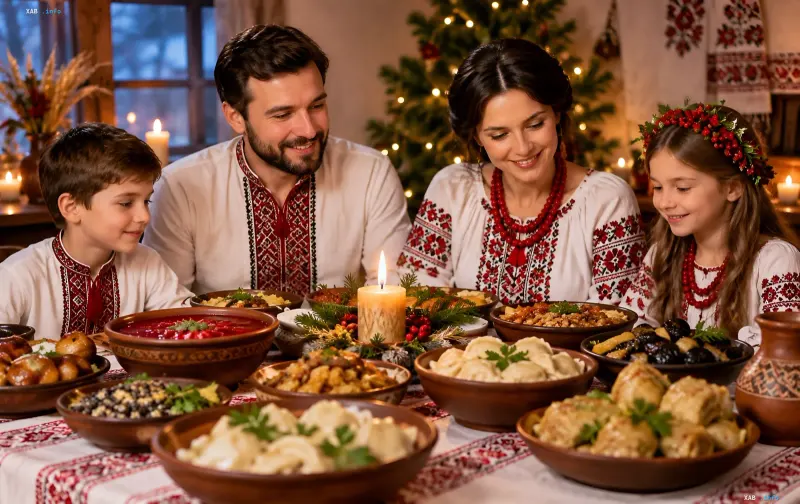
Sviatvechir concludes the period of the Christmas Fast and is dedicated to spiritual preparation for meeting Christmas. In church customs, this day is associated with prayer, worship services, and the anticipation of the birth of Jesus Christ. Traditionally, the family gathers at the table in the evening when the first star appears in the sky, symbolizing the Star of Bethlehem from the evangelical story. At the same time, waiting for the first star is primarily a folk tradition, whereas the main essence of the evening is joint prayer, gratitude, and family unity. One of the best-known rules is to prepare twelve meatless dishes for Sviatvechir. According to an article by Ivan Franko National University of Lviv titled "Customs and Rites of Ukrainians on Christmas Eve," this number is most often associated with the twelve apostles of Jesus Christ. Ethnographic sources also offer another interpretation: twelve dishes symbolize the twelve months of the year. There is no single mandatory list of dishes: according to the educational project "SlovOpis" of Borys Grinchenko Kyiv University, the menu varies depending on the region, family customs, and local culinary traditions. Among the unchanging elements are kutia, varenyky, holubtsi, fish, braised cabbage, borscht, compote, and pampushky.
Historical Roots: How Christmas Was Celebrated in the Early 20th Century
Interesting evidence of Ukrainian Christmas customs has been preserved in historical documents. The Central State Historical Archive of Ukraine in Lviv prepared an exhibition titled "Merry Christmas! Christmas Celebrations in Lviv at the Beginning of the 20th Century," which shows how residents of the city and region celebrated Christmas at the beginning of the last century. Archival materials show that the tradition of twelve dishes was widespread even then, although the specific menu depended on the family's wealth and local customs. In wealthier Lviv families, glass Christmas tree decorations were already used, and some owners attached small candles to spruce branches. A broader historical context is provided by material from the Patriarchal Catechetical Commission of the UGCC: the separate celebration of the birth of Jesus Christ in the Christian tradition was first established in the Roman Church under Pope Julius I in the middle of the 4th century, meaning Christmas was not initially an independent holiday but formed as a separate rite much later.
Modern Families: How Traditions Live Today
How Christmas customs are preserved in modern Ukrainian families is described by the Ukrainian Greek Catholic Church itself. In one of its materials, a family from the Kyiv region shares its own traditions: from preparing kutia according to a family recipe passed down from generation to generation to joint prayer and dinner with children and grandchildren. The library of Uman National University notes that Ukrainians have long preserved a number of customs associated with preparing the house and festive table, and many of them have survived to the present day in practically unchanged form. Thus, Sviatvechir remains not just a family dinner, but an important element of the spiritual and cultural identity of Ukrainian society.