Elon Musk has revealed technical details about the scaling of the world's largest supercomputer, Colossus 2, whose power consumption has already surpassed the 1-gigawatt mark. One of the main revelations was the explanation of the rigid mathematical logic behind expanding the cluster's computing power in batches of 110,000 Nvidia graphics accelerators. As it turned out, the upgrade process is constrained not by financial limits or datacenter space, but by the purely physical parameters of the switching equipment.
Fiber Optic Limit and Switch Architecture
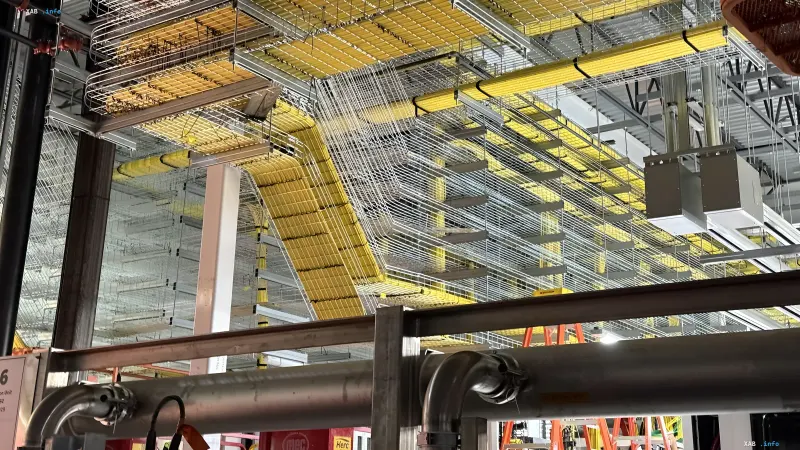
The increase in the number of Nvidia chips is strictly a multiple of 110,000 units due to the maximum bandwidth and capacity of the fiber optic cabling system. The supercomputer's central switch architecture is designed so that the maximum number of physical fiber optic connections that can be routed into a node without losing performance or risking failures is strictly regulated. Musk explained that this exact physical boundary of cable ports determines the scaling quantum for the entire artificial intelligence infrastructure.Cluster Evolution and Future Plans
To recap, the previous version of the system, known as Colossus 1, combined 150,000 Nvidia H100 accelerators, 50,000 H200s, and 30,000 GB200 architecture chips. The second generation of the supercomputer shifted to a fundamentally different scaling level: the baseline launch of Colossus 2 started with 110,000 Nvidia GB200 chips, followed by the planned deployment of GB300 line chips in massive blocks of 440,000 units.
New Capacity Deployment Schedule
The deployment pace of the new hardware is staggering market participants. According to current plans from Musk's engineering team, another 220,000 GB300 accelerators are scheduled to be fully integrated and operational next week. An additional batch of 220,000 chips will go live in November, and the final phase of the current expansion is targeted for late December, when another block of 220,000 GB300 accelerators goes online.Contradictory Data
Discussions have emerged within the expert community and tech media regarding the exact distribution of graphics accelerators across the different generations of Elon Musk's systems. While official statements emphasize a smooth transition to GB200 and GB300 architectures with a fixed 110,000 step, some analytical reviews point to potential logistic delays in advanced optics deliveries. Nonetheless, engineering reports confirm adherence to the stated timelines for commissioning power-intensive clusters into commercial operation.