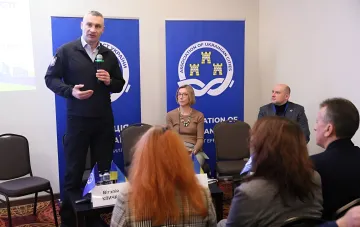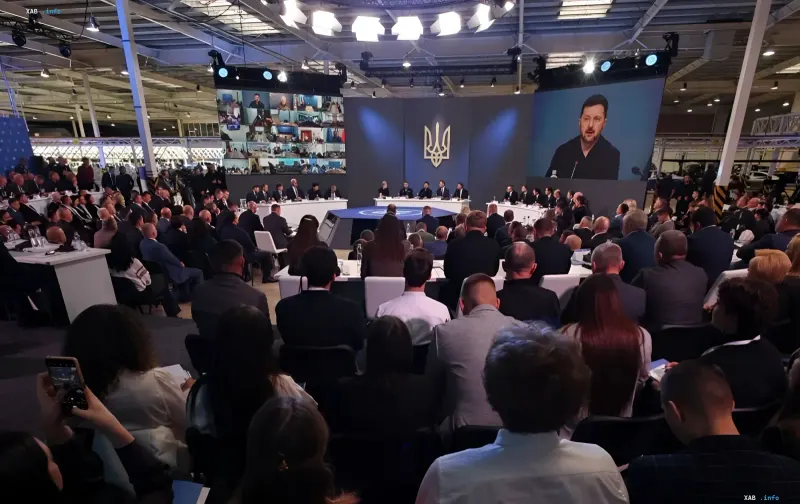
On November 24, the Congress of Local and Regional Authorities was held in Transcarpathia, turning into a heated discussion between the heads of hromadas and representatives of the central government. The trigger was a categorical statement by Finance Minister Sergii Marchenko regarding the impossibility of revising the reverse subsidy mechanism—an instrument that involves withdrawing funds from local budgets with a higher level of tax capacity in favor of less affluent communities. According to participants, this particular point became the trigger for a public conflict that escalated from the official stage into backstage disputes among the mayors of major cities.
Reverse subsidy: Ministry of Finance stance and hromadas' demands
Speaking at the congress, Finance Minister Sergii Marchenko rejected requests from community representatives to review the mechanism, citing the demands of international partners for the redistribution of revenues in favor of less financially secure hromadas. For local authorities, by contrast, this is a critically important resource: according to Perechyn Mayor Ivan Pohoriliak, the total amount of such deductions is about 19 billion hryvnias, which is equivalent to approximately 0.5% of the state budget. At the same time, for the hromadas themselves, these funds are not an abstract figure, but the basis for covering the additional burden caused by relocated businesses and the influx of internally displaced persons.
Figures and real burden on local budgets
Pohoriliak explained that even small communities that have hosted relocated enterprises face a multiple increase in expenses: "our budget has grown at least three times," while the challenges of ensuring the operation of the industrial park, industrial enterprises, and building housing for IDPs who are employees of these enterprises "have grown hundreds of times." According to him, the growth in revenues after enterprise relocation does not compensate for the costs of hospitals, kindergartens, and schools, the burden on which has increased manifold. Dnipro Mayor Boris Filatov cited a comparable estimate—about 20 billion hryvnias for the whole country, or 0.57% of the budget—and emphasized that "the reverse is not state budget money," but a resource without which hromadas cannot cope with the consequences of shelling and population redistribution.
Filatov and Sadovyi: A discussion that went beyond the stage
The heated discussion in the backstage was initiated by Dnipro Mayor Boris Filatov, joined by Lviv Mayor Andriy Sadovyi and other community leaders. Filatov pointed to a specific case: after the destruction of part of the Novokodatskyi district, Dnipro was allocated a subsidy of 270 million hryvnias, but in fact, the city received only 170 million. "Colleagues, do not hesitate to talk about problems. Why did we gather here—just to sit? Our communications are bursting, hydrodynamic shocks occur after every strike. We are shelled dozens of times," he stated, adding that "human destinies cannot be viewed only through figures" and that 220 affluent hromadas could make the rest insolvent.
Criticism of the format: "sit quietly, applaud loudly"
Alongside the financial dispute, congress participants expressed dissatisfaction with the format of the event itself. Head of the Transcarpathian Regional Council Andriy Sheketa noted that there were many people in the hall who tried to take the floor but were not given the opportunity: "And even on the broadcast, we see that someone is stubbornly ignored, and when it is no longer possible to ignore, like, for example, Sadovyi, they immediately try to put him in certain frameworks." In his opinion, excessive control and "direction" of the process made it impossible to raise acute questions that had not passed preliminary filters. Viktor Bobyrenko, head of the NGO "Bureau of Policy Analysis," characterized the atmosphere even more harshly in his post: "Everyone was warned—sit quietly, applaud loudly, and do not stand out. Questions should be asked by specially prepared people according to certain theses.">
Context: Why the dispute over the reverse became a symbol of the divide
The conflict at the congress in Transcarpathia fits into a broader context of tension between the center and the regions amid budget deficits, which, according to Filatov, are estimated in the range of 10 to 70 billion euros. For hromadas, the dispute over the reverse subsidy is not so much a matter of macroeconomic efficiency as a matter of the survival of social and communal infrastructure in the conditions of war and mass redistribution of population and business. The statements of the mayors of Dnipro, Lviv, and Perechyn, as well as the criticism of the format by Sheketa and Bobyrenko, indicate that the dialogue between central agencies and local authorities remains limited, and key financial mechanisms affecting the life of communities continue to be adopted without full consideration of regional positions.