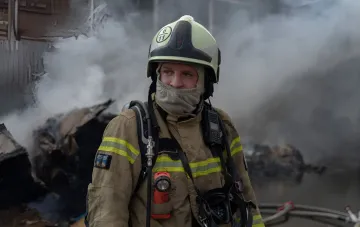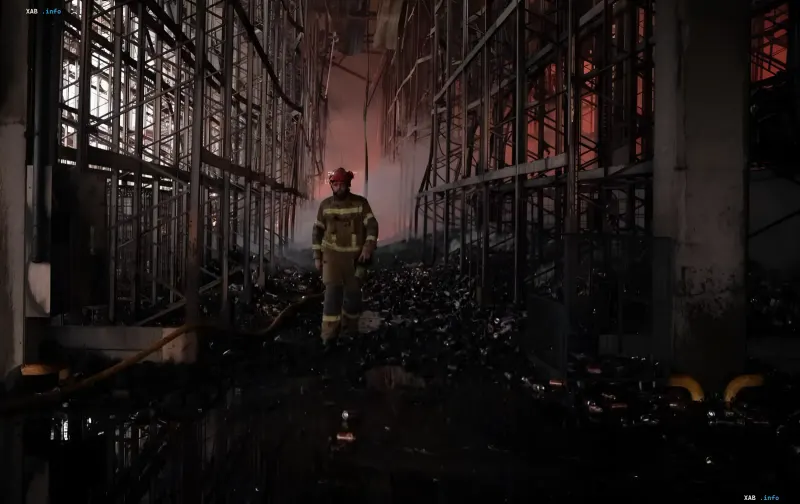
The night of August 5th became one of the most tragic for the Kyiv region. Russian forces carried out a large-scale missile and drone attack, employing ballistic missiles. The main impact was felt in logistics hubs, warehouses, and residential areas. According to the Air Force of the Armed Forces of Ukraine, none of the ballistic missiles were intercepted, although air defense forces managed to suppress or shoot down 98 strike drones.
Casualties and Destruction in Kyiv
In the capital, the consequences of the strike were recorded in the Holosiivskyi, Obolonskyi, Desnyanskyi, and Sviatoshynskyi districts. According to the Kyiv City Military Administration, one person died, and another 26 were injured. Fires broke out in residential and non-residential buildings in the Obolonskyi district. In the Holosiivskyi district, a system containing about 300 liters of ammonia was damaged; however, the leak was insignificant and did not pose a threat to the population.
Against the backdrop of fires and emissions, an elevated level of air pollution is observed in all districts of Kyiv. Rescuers continued searching for people under the rubble in the Holosiivskyi district, where warehouses and non-residential buildings were burning.
Tragedy in the Kyiv Region
The situation in the region turned out to be critical. According to the State Emergency Service (SES), 14 people died, and another 27 were injured. The highest number of casualties was recorded in the Brovary district — nine dead. Another four people died in the Bucha district and one in the Fastiv district.
Particular attention was drawn to the tragedy near the "Kvitneve" railway station. The Head of the Brovary District State Administration, Vitaliy Bigun, reported that people did not make it onto the last train, which was delayed. "Currently, eight dead are known. Three people are still in question, and about 12 people are in the hospital," he said on the TV marathon.
Strike on Logistics and Environmental Consequences
Russia attacked key infrastructure: logistics centers, warehouses, and railway platforms. An excess of nitrogen dioxide levels was recorded in Brovary after the attack. Mayor Ihor Sapozhko confirmed that no exceedances were found in the Shevchenko Street area, but in the Heroes of Ukraine Street and Torgmash area, the nitrogen dioxide level reached 0.26 mg/m³ against a norm of 0.2 mg/m³. Air ventilation helped reduce the concentration of harmful substances.
In "Ukrzaliznytsia" (Ukrainian Railways), it was reported that the logistics and railway infrastructure in the Brovary district came under attack. Train movement and station operations were temporarily suspended, and passengers and workers were evacuated.
Destruction of "Epicentr" Facilities
One of the most significant consequences of the attack was the destruction of the production and logistics infrastructure of the company "Epicentr". Russian missiles hit two key logistics complexes. In Kyiv, the logistics center on Viskozna Street burned down completely. In Kalynivka, an employee of the company died, and three others were injured.
A missile also hit the Epicentr Ceramic Corporation factory. As a result of the strike, production furnaces were completely destroyed, and the enterprise ceased operations. Two large warehouse complexes were destroyed, and 20 employee vehicles burned out. The company stated that it is temporarily relocating ceramic tile production to its facilities abroad. Restoring the destroyed production will take at least one and a half to two years.
Damage to Other Logistics Giants
In the Brovary district, about five locations were also damaged, where logistics companies were attacked, in particular Fozzy Food. The most well-known assets of the group are the retail chains "Silpo", "Fozzy", and "Trash!". In addition, residential buildings were damaged, and rescuers continue to extinguish a fire at one of the largest logistics hubs engaged in cargo transportation.