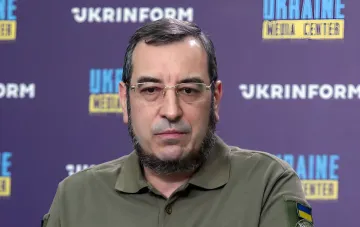
Timofiy Yurkov, co-founder of Contra-Drone, stated on the RBC-Ukraine podcast "TSE BAZA" that the primary threat to Kyiv's bridges comes not from Shahed drones, but from ballistic missiles, against which there are currently no effective electronic warfare (EW) countermeasures. According to him, ballistics corrects its own trajectory at extremely high altitudes, where calculations take place in conditions close to space, making it impossible to jam the signal via EW. Shaheds, on the contrary, suffer from navigation errors that prevent them from consistently striking bridge structures: in the final 20–25 kilometers of flight, the CRPA antenna is jammed, and the drone effectively loses precise navigation.
Why Shahed Drones Rarely Hit Bridges
Yurkov explained that in recent months, isolated instances of bridges being struck by air attack weapons like Shaheds have been recorded, which is due to the physical navigation limitations of the drone. When the CRPA antenna is jammed in the final phase of the trajectory, the drone cannot precisely determine its position and, consequently, its target. In rare situations, a Shahed might catch the protective mesh net over Kyiv, but such episodes, according to the expert, are extremely rare. Thus, bridge structures remain vulnerable primarily to ballistic missiles, which do not depend on satellite navigation during the trajectory correction phase.
Shrapnel Impact and Cluster Munitions
The nature of the destruction caused by ballistics deserves special attention. Yurkov emphasized that the shrapnel impact of ballistic missiles, especially when using cluster munitions, spreads over a significant area. According to his data, the zone of human-hazardous shrapnel action can reach 500–700 meters. This means that even in the absence of a direct hit on the bridge structure, the consequences of the strike affect adjacent infrastructure and pose a serious threat to civilians within a radius of hundreds of meters from the impact point.
The Problem of Interception Cost
A key difficulty pointed out by the expert lies in the economic disproportion: shooting down a ballistic missile worth millions of dollars is only possible with an interceptor of comparable cost, primarily a Patriot-class missile. According to Yurkov's assessment, a cheap analogue or universal solution capable of effectively neutralizing ballistics is not anticipated in the foreseeable future. He directly urged Western partners to provide Ukraine with IRIS-T systems or additional missiles for Patriot, as ballistics is the only significant threat to Kyiv's bridge structures. For comparison, the expert noted that the Shahed threat was successfully overcome within a few weeks of their mass deployment, whereas the situation with ballistics is fundamentally different.
The Evolution of Spoofing Tactics and CRPA Antenna Protection
Yurkov also commented on the geo-position spoofing tactics, where the drone's coordinates were replaced with points in Latin America or other remote regions. According to him, this method previously worked extremely effectively: Shaheds turned around and flew back toward Russia. However, as the expert noted, for every action, there is a reaction. Modern CRPA antennas are protected in such a way that the drone can analyze the physical feasibility of the spoofed point: if a second after receiving coordinates in Latin America or the Moscow region the time required for such movement is objectively insufficient, the drone rejects this point and continues navigating via real satellite signals. If the spoofing possesses sufficient power to completely block real satellite signals, the drone switches to inertial navigation, which is essentially equivalent to jamming.
Context: Consequences of the October 22 Attack
The relevance of the topic is underscored by recent events: following the night attack on October 22, metro traffic between the left and right banks of Kyiv was suspended due to damage to the South Bridge. The incident once again drew attention to the vulnerability of bridge infrastructure to ballistic weapons and the urgent need to provide Ukraine with air defense systems capable of intercepting missiles of this class. The expert community, according to Yurkov, does not expect a rapid technological breakthrough in this area, making the supply of Patriot and IRIS-T a priority for ensuring the security of the capital's critical transport infrastructure.