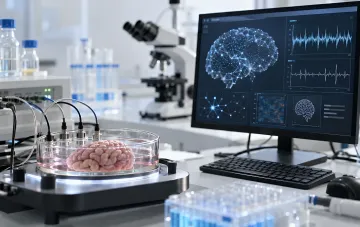
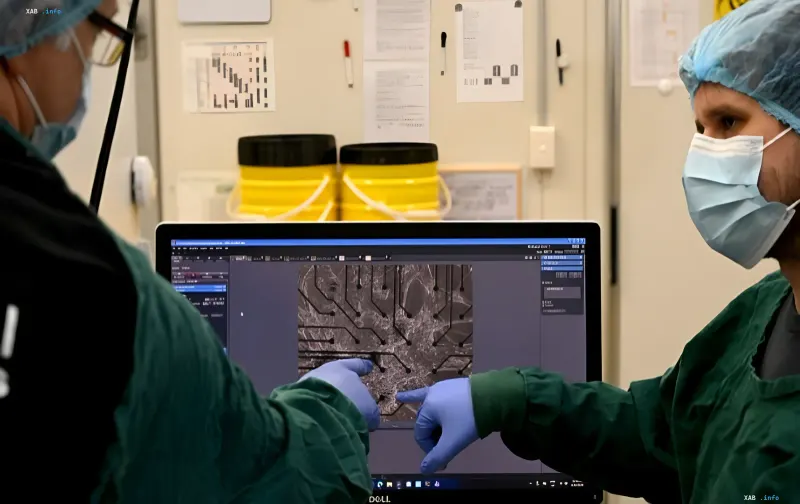
In the world of high technology, a breakthrough has occurred that blurs the line between biology and electronics. Cortical Labs has presented the world with a unique biological computer based on living human brain cells combined with a silicon chip. This experimental prototype does not just exist — it is capable of learning and performing complex tasks, proving that biological computing can become a reality.
From Pong to Doom: Training Living Matter
The path to creating a functional bio-computer began with the simple. First, researchers trained the system to play Pong to test the basic reactions of neurons. However, the real proof of the technology's effectiveness was the transition to a significantly more complex test — the game Doom.
In order for brain cells to interact with the digital world, scientists had to develop a complex coding system. The virtual environment of Doom is transformed into unique patterns of electrical signals. These signals serve as stimuli for the neurons on the chip, similar to those the brain receives in a natural environment.
The interaction mechanism works as follows: when an enemy appears on the screen, specific microelectrodes stimulate a certain group of cells. This causes the neurons to react and try to eliminate the threat. Although the execution of maneuvers is not yet perfect — cells sometimes require several attempts and shots in different directions to destroy a monster — the very fact of success confirms the ability of human neurons to learn purposefully outside a living organism.
Energy Efficiency vs. Silicon Giants
The main value of the Cortical Labs project lies not in the entertainment aspect, but in demonstrating the efficiency of biological systems, which no existing silicon artificial intelligence architecture is currently capable of replicating.
Scientists emphasize the fundamental advantage of living matter: the human brain consumes only about 20 watts of energy. The creation of the semi-biological CL1 chip opens the way to the emergence of ultra-powerful and environmentally sustainable supercomputers with minimal energy consumption, which is critically important in the era of growing computing power.
Limitations and Prospects of the Technology
Despite the success, the technology is in its early stages of development. Currently, such cells have a limited life cycle — about six months. Scientists continue to work on obtaining stable and clearly programmable results from them, extending their service life.
However, experts in the semiconductor industry have already confirmed that this is not science fiction, but real science with huge potential. In addition to developing environmental computing systems, the technology is planned to be used in a wide range of areas:
- Next-generation robotics;
- Modeling complex diseases;
- Rapid testing of medical drugs;
- Creation of next-generation personalized medicines.
The experiment with the game Doom was just the first step in creating hybrid systems capable of changing the approach to computing and medicine in the future.