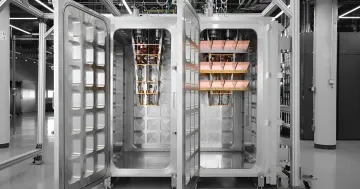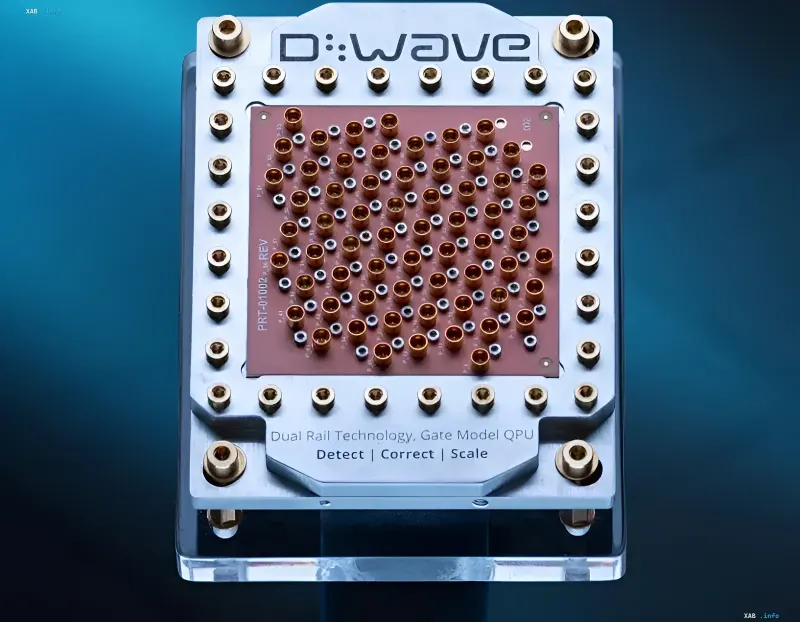
In August 2026, D-Wave, traditionally known as the world leader in quantum annealing, is making a decisive leap into a new era. Recently presenting research results in the journal Nature, the Canadian giant demonstrated a prototype of a new quantum processor operating on the gate model principle. This is a landmark event confirming that D-Wave has successfully transitioned from specialized optimization tasks to creating universal quantum computers capable of solving a wide range of computational problems.
Revolution in Architecture: Dual-Rail Qubits
The main achievement described in the new work is the demonstration of a fundamentally new approach to combating errors—the main problem in quantum computing. D-Wave researchers presented an element based on dual-rail technology. Unlike traditional qubits, where the quantum state is stored in a single element and is extremely sensitive to external interference, in the new architecture, the state is distributed between a pair of coupled resonators.
This physical feature allows the system to detect errors directly at the qubit level. If a failure occurs unnoticed in a standard processor, here the architecture itself signals which specific qubit has failed. This fundamental change allows for error detection without using bulky additional correction circuits, significantly simplifying the path to creating fault-tolerant systems.
Overcoming the Interaction Barrier
Until recently, there was a serious technical problem: when connecting such 'smart' qubits to perform joint operations, their ability to self-diagnose was often lost. However, in the published work, D-Wave presented a two-qubit quantum gate that allows qubits to interact and create quantum entanglement while maintaining the ability to detect errors.
In experiments, this gate demonstrated a fidelity of about 99.9% when performing operations lasting 500 nanoseconds. According to the developers, this architecture allows reducing the level of logical errors by approximately ten times at each transition to the next level of correction code. This opens the way to creating logical qubits based on fewer physical components, which is critical for scaling quantum computers.
Contradictory Data
Despite the enthusiastic response from the scientific community, the reaction of financial markets to the news was ambiguous. On the one hand, experts in quantum physics call the publication in Nature proof that D-Wave is successfully implementing its roadmap for creating universal machines. On the other hand, analysts note that the company's stock (QBTS) continued to decline immediately after the announcement.
While technical reports speak of a breakthrough in hardware, some investors express skepticism, pointing out that the demonstrated principle currently works only on a system of two interacting qubits. According to conservative analysts, a fully fault-tolerant quantum computer capable of solving commercial tasks is still far away. Thus, there is a gap between the technical validation of the technology and investors' expectations of immediate commercial returns.
Scaling Strategy
Today, error correction is considered the main obstacle on the path to practical quantum computers. Usually, to protect one useful logical qubit, many physical qubits must be used, requiring huge resources. D-Wave's new technology changes this balance: if the processor knows in advance where an error occurred, it is significantly easier to correct it, and potentially less additional equipment is required.
D-Wave positions this step as key to implementing its 'Detect | Correct | Scale' strategy. The presented prototype, marked as 'Gate Model QPU', confirms that the company is ready to compete with players like IBM and Google in the segment of universal quantum computing, offering a unique hardware solution to the problem of decoherence.