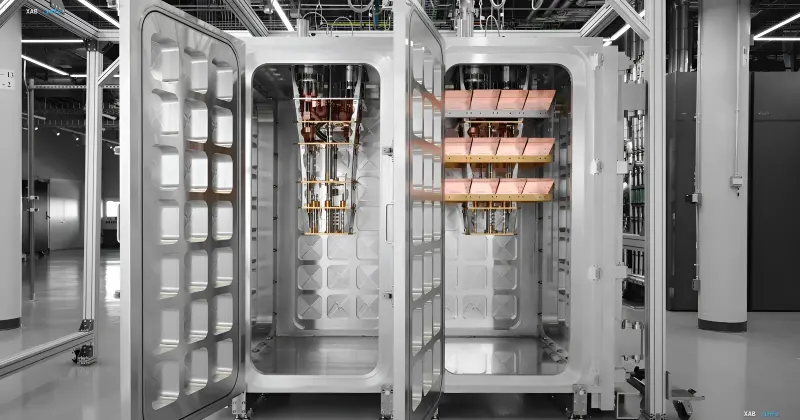
IBM has taken a significant leap forward in quantum computing by introducing a unique cooling system. The new device is capable of lowering temperatures to approximately 10 millikelvins, equivalent to nearly -273.14 °C. This makes the setup 180 times colder than deep space and addresses critical challenges in scaling quantum technologies.
Core Technology and Ultra-Low Temperatures
Superconducting quantum computers rely on qubits, which are extremely sensitive to external noise and temperature fluctuations. Thermal effects can disrupt fragile quantum states and lead to fatal computational errors. This is why IBM processors require maintaining temperatures below 15 millikelvins. To achieve this, the company's engineers utilize complex helium compressors, dilution chillers, and multi-layered thermal and electromagnetic shielding.
Modular Approach to Cooling
The main challenge for engineers was not just reaching extreme cold, but scaling the system as the number of chips grows. Building a single massive cooling unit for hundreds of processors would result in immense maintenance complexity. Therefore, IBM chose a modular path, dividing the system into independent units approximately 2.4 meters in height and width. Each module provides up to 12 times more wiring space, ensuring stable equipment operation.
Innovative L-Shaped Connectors
To integrate disparate modules into a single computing network, IBM specialists developed a specialized superconducting aluminum cable about a meter long—the so-called L-connector. This technological solution allowed researchers for the first time to connect quantum processors located in separate cooling chambers while maintaining the required operating temperature. This paves the way for large-scale multi-modular architectures.
Future Plans and the Quantum Starling System
The deployment of IBM's modular cooling architecture is scheduled for 2027, when the first multi-unit systems will integrate about 1,000 qubits. This technological breakthrough lays a solid foundation for realizing the ambitious Quantum Starling project, slated for deployment by 2029. The new system is expected to feature around 200 logical qubits with the capacity to execute up to 100 million quantum gates, vastly outperforming modern supercomputers.