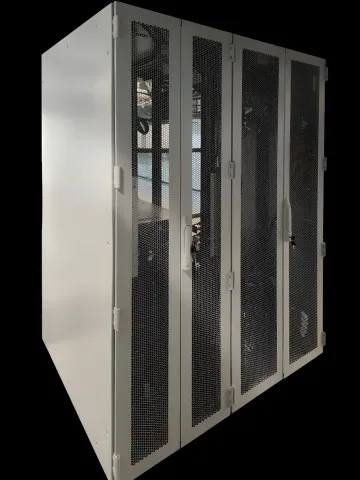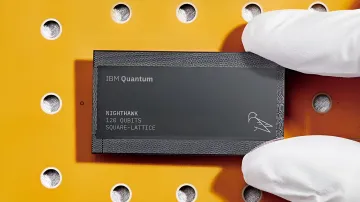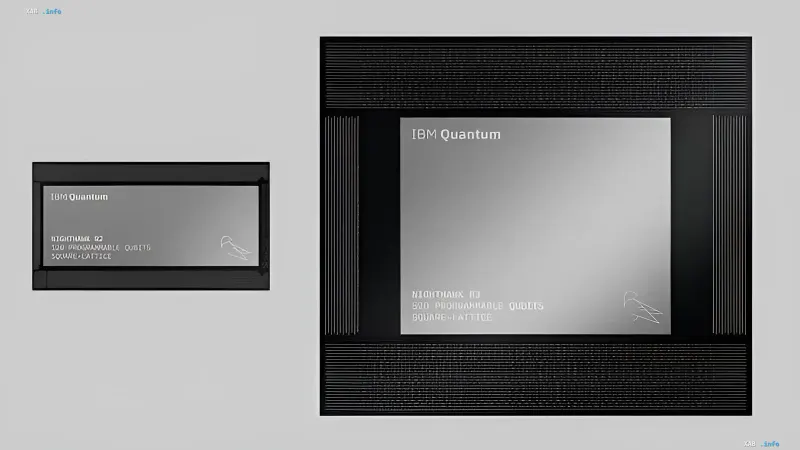
IBM has unveiled the third iteration of its quantum processor, the Nighthawk r3, which triples the number of programmable qubits compared to its predecessor and lays the architectural foundation for building the first-of-its-kind two-rack quantum supercomputer. This was announced on November 11, 2026. The new device does more than just increase computing capacity: it introduces ten inter-chip l-couplers that allow individual processors to be combined into a single system, while retaining the signature high-speed qubit reset scheme that has become a key advantage of the Nighthawk platform.
Triple Qubit Increase and New Architecture
The Nighthawk r3 processor is designed to execute up to 10,000 quantum operations using 520 programmable qubits. The total number of physical qubits on the chip is 2,034. The architecture maintains a square-lattice qubit connection scheme, but for the first time includes ten inter-chip l-couplers. These elements are designed to transfer quantum states between individual processors and combine multiple chips into a single computing system. For comparison, the previous Nighthawk r2 version, which became available in September 2026, enabled quantum circuit execution with more than 7,500 operations on 120 programmable qubits, while the original Nighthawk r1 was announced in November 2025.
High-Speed Qubit Reset — The Key to Result Accuracy
One of the breakthrough solutions implemented back in version r2 and inherited in r3 is the high-speed qubit reset scheme. While obtaining a new sample required 250 microseconds for the Nighthawk r1 processor to reset qubits, this interval is reduced to approximately 1 microsecond in r2 and r3. Because quantum computing relies on statistical sample analysis, reducing the time between successive circuit runs directly increases result accuracy: the more runs and measurements that can be performed per unit of time, the more reliable the final conclusion. According to IBM, customers and partners have already executed over 34 billion quantum circuits on r2, achieving up to a 19x speedup relative to the company's previous processors.
Inter-Chip Connections and the Path to Scalability
IBM has already demonstrated the transfer of a quantum state between Nighthawk r1 processors via four l-couplers with an accuracy of 99.3%. The company's next goal is to bring this figure to 99.9%, as reported a couple of weeks ago. The ten inter-chip connections in r3 create the necessary infrastructure for scaling: it is through these that individual racks will be integrated into a single system. IBM emphasizes that there are no longer any obstacles to building and launching a two-rack cluster.
Cryogenic Infrastructure and Plans for 2027
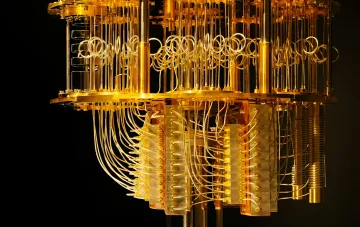
In 2027, IBM intends to combine two Nighthawk r3 processors into a single system with 1,040 programmable qubits — the first quantum supercomputer of its kind. The cryogenic infrastructure for such scaling has already been tested: the company demonstrated the combination of two cryogenic modules into a single system that reached an operating temperature below 15 mK in less than five days. This is a critically important parameter, as quantum processors function only under ultra-low temperatures close to absolute zero.
Integration with Classical HPC Systems
Parallel to the development of quantum hardware, IBM is strengthening the integration of quantum processors with classical high-performance computing (HPC) systems. This combination is necessary to process measurement results, suppress errors, and implement quantum error correction algorithms. Recently, IBM, in partnership with Oak Ridge National Laboratory (ORNL) and AMD, launched a new platform for quantum error correction that physically integrates Nighthawk processors with ORNL's Umbra high-performance computing system, powered by AMD Instinct MI355X GPUs and 5th-gen AMD Epyc processors. IBM notes that as quantum computing platforms become more complex, their classical supporting infrastructure will also become more sophisticated.
Practical Results for Clients
IBM clients are already recording promising results from this integration. For example, using the new environment, the Cleveland Clinic and RIKEN automatically processed 608 million samples for modeling biologically significant structures, which is 33 times faster than using an unautomated workflow. Energy utility E.ON reported a 15x speedup when using quantum machine learning for energy grid optimization. In other cases, calculation speedups varied both higher and lower, which, according to IBM, does not diminish the value of the new offerings but offers hope for breakthroughs across many fields of science and engineering.